
Using These Kinds of Words Undermines Your Leadership Credibility
I’ve sat across from some of the most accomplished leaders in America — Fortune 500 executives, surgeons, vice presidents, and top-producing sales leaders — and one thing I’ve noticed consistently is this: the difference between a leader who connects with their audience and one who doesn’t often comes down to the words they choose.
Not their slide deck. Not their wardrobe. Not even their data. Their words.
I learned this early in my career as a three-time Emmy Award-winning television producer. In the newsroom, we understood that language is never neutral. Every word either builds credibility or quietly borrows against it.
And nowhere did I see this illustrated more clearly than during a recent coaching session with a group of senior leaders at a $20 billion construction company.
The Moment Everything Stopped
We were mid-session — cameras on, playback running — reviewing how each leader communicated the company’s value proposition to clients. One of the executives stepped up. Polished. Confident. He launched into his pitch about how the company delivers cost efficiency for its clients.
Then he said it.
“We will hopefully get you more money.”
I pressed pause. We watched it back together.
That one word — hopefully — had done something subtle but significant. It had introduced doubt into a message that didn’t need any. You could see it happen on screen in real time.
Here’s what made the moment so interesting: when I asked this leader whether he genuinely believed his company saves clients money, he didn’t hesitate.
“One hundred percent,” he said. “I know we do.”
So why did he say hopefully?
Most leaders have never been shown how closely their word choices reflect their level of conviction. They’ve been developed on strategy and content, but rarely on the language itself. They walk into boardrooms, sales meetings, and presentations with deep expertise — and occasionally, without realizing it, language that quietly undercuts the message they’re trying to deliver.
Why WordsMatters More Than Most Leaders Realize
Language works on two levels at once: the informational and the emotional. Your audience is processing what you’re saying and how much you believe it — simultaneously.
Hedging words signal uncertainty, even when none exists. Words like hopefully, maybe, I think, sort of, and kind of can unintentionally transfer a speaker’s anxiety to the listener. They soften a message that was never meant to be soft.
Confident, direct language does the opposite. It gives your audience something solid to stand on. Leaders who connect well in rooms — who close deals, earn trust, and move people to action — tend to speak in clear, grounded statements rather than qualified ones.
The data backs this up. Companies with leaders who possess effective communication skills have produced a 47% higher return to shareholders over a five-year period — according to the Watson Wyatt Communication ROI Study. And yet,poor communication costs U.S. businesses an estimated $1.2 trillion annually in lost productivity, increased turnover, and customer churn (Grammarly & The Harris Poll). That’s not a soft-skills problem. That’s a bottom-line problem.
Weak Words vs. Powerful Words: A Practical Look
The shift is often simpler than people expect. Here’s what it looks like side-by-side.
- Hopefully Vs. We will / We do
- I think / I believe Vs. I know / I’m certain
- Kind of / Sort of Vs. Absolutely / Definitively
- Maybe / Perhaps Vs. Our clients experience…
- We’ll try Vs We deliver
- I just wanted to say Vs Her’s what I want you to know
- Does that make sense? Vs The result is…
- Basically / Actually Vs. This saves / generates / creates
- If that’s okay with you Vs. Here’s what happens…
- I’m not sure, but… Vs. The data confirms…
Look at that construction leader’s original line again: “We will hopefully get you more money.
Now read the revised version: “We save our clients money. That’s what we do.”
Same leader. Same company. Same results. Entirely different impact. That’s what a single word change can do.
“You met people where they needed you to be, and pushed just the right amount based on each personality. I was truly blown away watching that — it’s a real talent that I don’t know I’ve seen before.”
— COO, $15 Billion U.S.-Based Company
This Goes Beyond Communication — It’s a Leadership Issue
Weak language isn’t a personality quirk. It’s a pattern — and over time, it can quietly cost organizations real opportunities.
When a physician presents to a hospital board using hedging language, it can erode confidence in their recommendations. When a sales leader uses too many qualifiers in a major account meeting, deals stall. When an executive briefs the C-suite tentatively, the perception of their readiness for greater responsibility can suffer — even when that readiness is absolutely there.
The research on this is particularly striking in healthcare. Patients whose physicians have not been trained in communication skills face a 19% higher risk of nonadherence to treatment — meaning the words a physician chooses don’t just affect perception; they affect whether patients follow through on their care. And according to research from the Agency for Healthcare Research and Quality, poor communication is a contributing factor in the majority of malpractice suits.
For corporate leaders, the stakes are equally real. One in five business leaders has lost a deal or client due to poor communication (Grammarly & Harris Poll). Among customers who moved to a competitor, 66% reported doing so because of the poor communication skills of company representatives.
The leaders in that $20 billion construction company had every reason to speak with confidence. The only thing missing was the awareness that their language wasn’t fully reflecting what they already knew to be true.
“At Janicek Performance Group, we often say: your words are a mirror of your mindset. When your language is tentative, your audience may question your conviction — even when it’s completely solid.”
— Kathryn Janicek, Founder & CEO, JPG
How We Work With Leaders To Shift Their Word Choice
We don’t hand leaders a list of “approved words” and call it a day. That produces scripted speakers, not authentic ones.
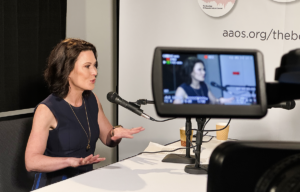
What we do instead is put leaders on camera in real conditions, then watch the playback together. It’s one of the most valuable things we do — because most leaders have never had the chance to see themselves the way their audience sees them. That perspective changes everything.
“When I am on set, whether television or radio, I know I’m prepared because she prepared. Her drive, determination, attention to detail, and professionalism really sets her apart from anyone else. I know I’m in good hands.”
— Dr. Lynn O’Connor, M.D., M.P.H., F.A.C.S. — Colorectal Surgeon, National Speaker & Author
The investment in this kind of development also carries measurable returns. A Metrix Global study found that executive coaching delivers a 788% return on investment based on increases in productivity and employee retention. The International Coaching Federation reports that over 87% of businesses see strong financial return from executive coaching, with an average ROI of 5.7 times the investment. And 75% of leaders report that the value of executive coaching is considerably greater than the time and money invested.
“Kathryn quickly understood the needs of our organization and helped energize and polish our key executives for an upcoming speaking event. We saw overwhelming improvement and look forward to continuing to work with her. There’s no one better.”
— Julia Weiss, Director of Communications, CoinFlip
Who This Work Is Designed For
If you’re a Chief Human Resources Officer, Chief Medical Officer, VP of Talent Development, or an executive responsible for growing the leaders around you — this kind of coaching tends to be where real, lasting change happens.
We work with Fortune 500 companies looking to strengthen how their leaders show up in high-stakes conversations. We also work with medical associations and health systems whose physicians and executives need to communicate with clarity and confidence — whether they’re presenting to a board, speaking at a conference, or building trust with patients and colleagues.
“Kathryn has an innate ability to connect with people, meet them where they are, and bring them farther than they thought they could go. Cookie-cutter trainings just don’t cut it — she adapts, pivots, and freely shares her knowledge and most importantly her passion.”
— College of American Pathologists
Where This Leader Landed
That construction executive left our session with something more valuable than a corrected sentence. He left with a new level of self-awareness he’ll carry into every room he walks into.
He no longer says hopefully. He says we will. He says we save you money — because that’s the truth, and he’s always known it. Now his language reflects it.
That’s the shift we help leaders make at JPG.
If you’re thinking about what that could look like for your team, we’d love to have that conversation. Visit janicekperformancegroup.com or call us at 312-566-8216 to schedule a discovery call.
About Janicek Performance Group: Premier Executive Coaching in Chicago
Based in Chicago and serving leaders worldwide, Janicek Performance Group is an Emmy Award-winning executive coaching firm specializing in leadership development, public speaking coaching, executive presence training, media training, and sales executive coaching. For over 25 years, we’ve helped Fortune 500 executives, medical society leaders, top physicians, and C-suite communicators develop the presence and leadership communication skills that define influential leadership.
Our public speaking training programs serve Fortune 500 companies, multi-billion dollar enterprises, medical societies, and executive teams across industries. We provide customized executive coaching that delivers measurable improvements in presentation skills, leadership communication, and executive presence.
If you’re ready to transform from expert to influential leader, refine your presence, project confidence, and take control of your message, reach out today to learn how we can help.