What Your Face Is Costing You in the Boardroom, the Sales Meeting, and on Stage
I recently led a leadership training session at a $20 billion company with hundreds of locations across North America and thousands of employees. We did what we always do at JPG — recorded role-playing scenarios and watched them back together.
His content was awesome. He knew it. We all knew it.
But when we hit play, something else showed up.
His face.
And here’s the thing — he saw it first. Watching himself back, he said something along the lines of, “I could maybe be a little more approachable, right?”
That’s the light bulb moment. That’s what I live for.
Eye contact. Looking like you want to be there. SHOWING you want to be there with your FACE. Those aren’t soft skills — they’re the difference between a message that lands and one that doesn’t.
Because here’s what nobody warns you about: sometimes your face says “that was a really dumb question” — even when your brain never thought it for a second. And the person across from you? They felt it. Whether it’s a client in a sales meeting, a board member asking a hard question, or a leader you’re managing up to — that flash of expression costs you more than you know.
A small tweak. A massive shift.And it’s exactly why leadership communication training can’t just be about what you say. It has to be about how every part of you delivers the message.
The Face You Don’t Know You’re Making
Here’s the thing nobody tells you in business school, and nobody tells you in medical school either: your face is always communicating, whether you intend it to or not.
In that session, this leader’s face did something I see constantly in Fortune 500 boardrooms, sales meetings, and keynote stages across the country. When a client or colleague asked a question, his expression — just for a split second — said: “Are you seriously asking me that right now?”
He didn’t mean it. He wasn’t thinking it. But his face said it.
And I promise you, the client on the other side of that table felt it.
This is the gap that no amount of slide preparation closes. It’s why executive communication coaching exists — not to help brilliant people become more knowledgeable, but to help them align what they know with how they show up.
Research by psychologist Paul Ekman found that basic emotions — happiness, sadness, disgust, fear, anger — can be read on the human face with up to 100% accuracy for happiness and approximately 80% accuracy for the others. (Source: Ekman, P. & Friesen, W.V. — Paul Ekman Research Overview, Wikipedia; as cited in Borg, J. (2013). Body Language: 7 Easy Lessons to Master the Silent Language.)
People are wired to read faces. They can’t help it. And neither can your clients, your board members, or your audience.
The Numbers Don’t Lie
If you think your PowerPoint deck or your talking points are doing the heavy lifting in a high-stakes meeting, I need you to sit with this for a moment.
Professor Albert Mehrabian of UCLA conducted research in the 1970s on how people communicate feelings and attitudes. His findings — still widely referenced in communication training for managers and executive development — suggested that when we’re communicating emotional content, body language and facial expressions carry the heaviest weight: roughly 55% nonverbal, 38% tone of voice, and approximately 7% the actual words spoken. (Source: Albert Mehrabian’s 7-38-55 Rule — Wikipedia;Mehrabian’s Rule — Toolshero)
Let that land — especially if you’re a leader whose job involves regularly persuading, inspiring, or reassuring people under pressure.
Your words — the thing you spent days preparing — may account for far less of what the room actually receives than you think. The rest? It’s your posture, your tone, and yes, your face.
Allan and Barbara Pease, authors of The Definitive Book of Body Language, analyzed thousands of recorded sales negotiations and found that body language accounted for the majority of impact in in-person negotiations — and that the person with the strongest argument doesn’t always win face-to-face the way they do over the phone. (Source: University of Texas Permian Basin — “How Much of Communication Is Nonverbal?”)
Think about that in the context of your next board presentation. Or your next sales call with a Fortune 500 client. Or the next time a top physician on your team is presenting research to hospital leadership.
This is why leadership and communication training has to go beyond talking points and delivery scripts. The whole person has to be prepared — from their opening posture to the split-second microexpression that flashes when a tough question lands.
What This Looks Like in the Real World
I work with some of the sharpest minds in business and medicine. C-suite executives at multi-billion dollar organizations. Top physicians at leading medical associations. Sales leaders at Fortune 500 companies. These are people who are exceptional at what they do.
And almost universally, they share a blind spot: they have never been shown what they actually look like in high-pressure moments.
When organizations reach out to us — whether they’re looking for communication classes for managers, executive communication skills training, or managerial communication training for an entire leadership tier — this is what I tell them: the gap isn’t knowledge. It’s self-awareness.
Here’s what I see most often:
In the sales meeting: The leader is listening to a client’s concern, and their face flashes irritation, impatience, or dismissiveness — even while they’re saying all the right words. The client picks up on the disconnect. Trust erodes. The deal gets harder.
In the board meeting: The executive fielding a tough question from a board member briefly looks annoyed before composing themselves. The board member notices. Their confidence in that leader shifts.
At the keynote: The speaker smiles during serious content, or furrows their brow when delivering good news, or makes no eye contact at all — staring instead at their slides. The audience disconnects.
None of this is intentional. All of it is costing you.
The VP of Media and Crisis Communications at a Fortune 50 company — someone who had worked with many media and public speaking trainers over 28 years — said this about our work together:
“Of course, she’s great at helping with body language, visuals, eye contact, bridging, flagging, landing messages. But where she really shines is in helping folks think about the impression they make and ensuring they’re seen, not just heard.”
That’s the work. Not just delivery. Impression.
Managing Up — And What Your Face Is Saying to Your Leaders
One of the things I pointed out in that training session is something I want every leader reading this to hear:
The way your face responds to your leaders’ questions matters just as much as it does in front of clients.
If your expression says “I can’t believe you asked that” when a board member or senior leader poses a question, you are managing up with your face — and not in your favor. Your ability to climb, to be trusted with more responsibility, to be seen as a leader worth investing in — all of it is quietly influenced by these micro-moments of facial expression.
This is not about being fake or performative. It’s about alignment. Your face should match your intention.
High-performing leaders manage their strategies and teams with precision. Leadership communication training brings that same precision to how they show up.
The President of a $20 billion construction company put it plainly after committing to this kind of work with his team:
“This training provides a competitive advantage for our entire organization. For those who fully commit, it can be life-changing.”
Why the Camera Doesn’t Lie
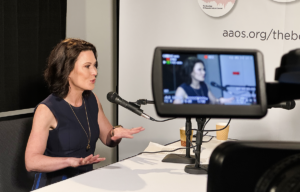
At JPG, one of the most powerful tools we use is video playback. We record our clients in role-play scenarios — sales calls, board presentations, keynote rehearsals — and then we watch it back together.
The feedback we give isn’t harsh. It’s surgical.
This is the heart of what great communication coaching looks like. Not a lecture. Not a checklist. A real-time mirror held up by someone who knows exactly what to look for — and how to help you fix it.
When leaders see themselves on camera, often for the first time in a real pressure scenario, the awareness shift is immediate. The COO of a $15 billion US-based company told us:
“You met people where they needed you to be, and pushed just the right amount based on each personality. I was truly blown away watching that — it’s a real talent that I don’t know I’ve seen before.”
Erik Peterson, Director of Learning Excellence and Technology at GAF, described the experience after working with our team on their senior sales leadership:
“Kathryn’s approach was not a generic training simply focusing on theory, but rather, she took the time to understand the strengths and opportunities for improvement of each one of our leaders in advance, and worked diligently with them over an extended period of time to improve their performance. The team gives feedback that is candid, clear, and important for our leaders to hear — delivered in a constructive but empathetic way that really resonates.”
Preparation doesn’t just mean knowing your content. It means knowing how you look and sound when you deliver it.
Media Training, PR Training, and Why Executive Communications Can’t Be an Afterthought
I spent 20 years in TV news before founding JPG. I’ve been in the hot seat. I know what it looks like when a leader walks into a media interview unprepared — and I know what it costs them.
When people ask me “what is media training?” or what PR training really means at the executive level, my answer is simple: it’s not spin. It’s preparation. It’s giving your leaders the executive communication skills to stay composed, credible, and on-message when the pressure is highest.
Media training for executives is no longer optional. In today’s 24-hour news cycle, a fumbled interview, an unguarded facial expression captured on camera, or a poorly worded response to a reporter’s question can unravel months of carefully built trust — with clients, investors, the public, and your own employees.
The same applies to crisis communication management. When something goes wrong — and at scale, it will — how your leader shows up in that first statement, that first press conference, that first internal communication, shapes everything that comes after. A facial expression that reads defensive or dismissive can be just as damaging as the wrong words.
This is why the organizations that invest in a serious communications coach — not just a one-time workshop but an ongoing relationship — are the ones that navigate crisis with credibility intact.
Michael Ziener, Senior Director at the American Cancer Society, said it:
“When I need the best in Chicago for media coaching, executive production, or telling ‘THE STORY’ — I go to Kathryn Janicek. There is no one else in the country I would rely on for my media and production strategies.”
Whether you’re looking for a media coaching partner, a crisis communications agency relationship, or deep executive communication coaching for your top tier of leaders — the throughline is the same: your people have to be prepared to communicate at the level your organization demands.
What You Can Start Doing Right Now
You don’t have to wait for a coaching session to start paying attention to this. Here are three things I tell every client, whether they’re coming to us for leadership communication training, media training for executives, or one-on-one executive communication coaching:
1. Record yourself. The next time you’re preparing for a big presentation, sales meeting, or board update, record a practice run on your phone. Watch it back with the sound off first. What is your face communicating without the words?
2. Manufacture eye contact and warmth before you need it. Before your next high-stakes meeting, spend 60 seconds consciously relaxing your face. Drop your jaw slightly, soften your forehead, and smile at something that genuinely amuses you. Your face carries residual tension — especially under pressure. Reset it intentionally.
3. Treat every question like the most important one you’ve received today. When a client, board member, reporter, or colleague asks something, your face should say “great question, I’m glad you brought that up” — even if you’re navigating internally. That openness keeps the conversation alive and the relationship intact.
Jennifer Tran-Kozmic, Senior Director of Beef at McDonald’s, shared what happened after committing to this kind of work:
“I’ve had to do a few large presentations since we worked together. I actually did one earlier this week in front of the SLT and major market leaders and received positive feedback. Though not 100% comfortable and still takes a lot of prep, I’m definitely looking more comfortable to the audience.”
That’s it. That’s the goal. Not perfection — visible, confident, authentic presence.
The Competitive Differentiator Nobody Talks About
After our executive communication skills training engagement with JP Morgan Chase, we received word that advisors who weren’t even in the room were asking when they could get in. Not because of an exit survey score — because colleagues heard about it secondhand and wanted in.
That’s what happens when training is built around the actual human beings in front of you, not a generic corporate curriculum.
Emily Negrin, from Miller Knoll, posted this on LinkedIn after her team’s strategic communication master course with us:
“The best training I’ve experienced in 10+ years. Period. The ROI was immediate. Between the compelling delivery and the wealth of ideas I’m ready to implement, I feel completely recharged.”
The organizations that invest in executive communications, presence, and emotional intelligence are the ones that close bigger deals, retain their best people, and command rooms that other leaders struggle to hold.
And it starts, sometimes, with something as small as the look on your face when someone asks you a question.
Colonel Patricia Klop, United States Marine Corps Reserve (Retired) — a 17-year educator and 30-year officer — described the experience this way:
“I was incredibly enlightened from Kathryn Janicek’s communication coaching. The coaching feedback was priceless and significantly improved my public speaking acumen, delivery, and effectiveness. For anyone who wants to improve their communication effectiveness from good to great, Kathryn Janicek is the catalyst to make that happen.”
Is Your Team Ready to Lead at That Level?
At JPG, we work with Fortune 500 companies, multi-billion dollar organizations, and leading medical associations to develop leaders who command attention, build trust, and drive results — in every room they walk into.
Our Emmy Award-winning coaches bring a combination of media coaching, leadership communication training, sales coaching, public speaking training, executive presence coaching, crisis communication management, and mindset coaching that you won’t find anywhere else. We don’t do cookie-cutter. We do transformation.
Whether your organization needs communication training for managers across a leadership tier, a private executive communication coach for a C-suite leader, media training for executives ahead of a major announcement, or a crisis communications partner you can trust when stakes are highest — we are built for exactly that.
If your top executives, top physicians, or top sales leaders are leaving opportunity on the table because of what they don’t know about how they show up — let’s talk.
Schedule a call with our team at janicekperformancegroup.com
About Janicek Performance Group: Premier Executive Coaching in Chicago
Based in Chicago and serving leaders worldwide, Janicek Performance Group is an Emmy Award-winning executive coaching firm specializing in leadership development, public speaking coaching, executive presence training, media training, and sales executive coaching. For over 25 years, we’ve helped Fortune 500 executives, medical society leaders, top physicians, and C-suite communicators develop the presence and leadership communication skills that define influential leadership.
Our public speaking training programs serve Fortune 500 companies, multi-billion dollar enterprises, medical societies, and executive teams across industries. We provide customized executive coaching that delivers measurable improvements in presentation skills, leadership communication, and executive presence.
If you’re ready to transform from expert to influential leader, refine your presence, project confidence, and take control of your message, reach out today to learn how we can help.