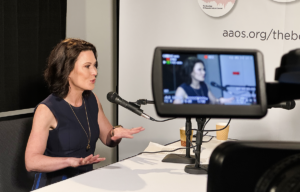

What you’re communicating and what the room is receiving might be two different things
I want to tell you something that might change the way you think about every presentation, sales call, and leadership conversation your organization has — starting today.
It has nothing to do with your slide deck. It’s not your data, your value proposition, or your closing technique. It’s something far more primal, far more powerful, and almost entirely overlooked in traditional leadership development programs.
It’s the rate of your speech.
At Janicek Performance Group, we’ve spent decades coaching executives, physicians, and top performers at some of the world’s most influential organizations — Fortune 500 companies, major medical associations, and global brands you interact with every day. And if I had to name the single most underestimated driver of executive presence, sales performance, and leadership trust?
It’s how fast — or how slow — you speak.
The $20 Billion Moment That Said Everything
A few months ago, I was running a leadership coaching intensive for a group of senior leaders at a $20 billion construction company. These were accomplished, highly intelligent people — the kind of executives who command entire divisions, manage massive projects, and have earned every seat at the table they sit in.
We were watching back a mock sales presentation one of their leaders had just delivered. I run these sessions intentionally — because there is no teacher like the camera. What you think you’re communicating and what the room is actually receiving are almost always two different things.
As we watched the playback together, he leaned forward and said it himself: “I was talking too fast. I was nervous — and that came through.”
He wasn’t wrong. But what I needed him to understand went deeper than just pace. I needed him to understand what his nervousness was doing to the person on the other side of that table — and why slowing down wasn’t just a presentation tip. It was a sales strategy. A leadership strategy. A trust-building strategy.
You Are Setting Your Audience’s Heart Rate With Your Rate of Speech
This is the insight that changes everything, and it’s backed by neuroscience. When you speak to another person, you are not just transmitting information. You are transmitting a physiological state.
When you speak quickly — rushed, pressured, anxious — you trigger a stress response in your listener. Their nervous system reads your urgency as a cue. Something is wrong. Something is moving too fast. Be cautious. Retreat.
When you speak with calm authority — measured, deliberate, unhurried — you tell their nervous system: You are safe here. This person knows what they’re doing. You can trust this.
“We actually set the heart rate of the person we’re talking to. If we’re really, really fast and really, really nervous — you know what it does? It makes them want to run. But if you slow down and make them calm and aware that they’re going to make a really great purchase, and they’re safe with you… that’s all in our rate of speech. Isn’t that amazing? It’s all in the power of how fast or slow we speak.“
— Kathryn Janicek, Live Coaching Session
Think about that in a sales context. Your top performers are walking into rooms with Fortune 500 decision-makers, physician leadership boards, and C-suite buyers. The moment they open their mouths and their nerves leak into their pace, they have already lost ground — before a single slide has been shown, before a single feature has been named.
The prospect doesn’t consciously think, “This person is talking too fast.” They feel it. They feel an inexplicable resistance. They feel the urge to slow things down, create distance, “think it over.” They retreat — not because the offer wasn’t compelling, but because their body told them to.
What the Research Confirms
This is not just coaching intuition. The science is clear and the numbers are striking.
- 93% of communication impact comes from non-verbal and vocal delivery — not content.
- 38% of how we are judged comes from tone, pace, and vocal quality alone.
- Only 7% of perception is shaped by the actual words we choose to say.
Albert Mehrabian’s foundational research on communication tells us that the words themselves carry only a fraction of our message. The rest — the vast majority — is carried by how we deliver them. Rate of speech sits squarely in that dominant 93%. (Source: Albert Mehrabian, UCLA — Silent Messages, 1971)
“Slower speech is associated with confidence, authority, and credibility. Faster speech signals anxiety, uncertainty, and pressure — regardless of what the content actually says.”
— Harvard Business Review, The New Rules of Executive Presence (2024)
The Anxious-Energy Tax Your Leaders Don’t Know They’re Paying
When you come into a room carrying anxious energy, when that nervous energy leaks into your pace, your listener doesn’t hear your expertise. They hear pressure. They don’t hear confidence. They hear someone who wants something from them. And the moment they sense that, the walls go up.
But here’s what happens when your leaders slow down:
- The listener’s nervous system calms. Resistance softens. Openness replaces defensiveness.
- The speaker projects authority without arrogance — the hallmark of true executive presence.
- The prospect feels genuinely heard and guided, not sold to. Decisions happen faster because trust is built faster.
- Team members feel steady and led — not managed or pressured.
- The pause becomes power. What feels like empty space to the speaker reads as gravitas to the room.
What This Means for Your Organization
If you lead a Fortune 500 company, a high-performing sales team, or a medical organization, you are deploying human beings into high-stakes conversations every single day. Those people are your brand. Their presence, their voice, their pace — that is your organization’s first impression.
And in most organizations, this is completely unaddressed. Leaders go through technical training, product training, clinical training — but no one teaches them how to walk into a room and command it before they’ve said a word. No one shows them the footage of what their nervousness actually looks and sounds like to the people across the table.
That’s exactly the work we do at Janicek Performance Group.
From our base in Chicago, we work with leaders worldwide — helping them develop the executive presence, vocal authority, and mindset that makes the difference between a leader who is merely competent and one who is truly commanding. We film. We play back. We show people what they cannot see themselves.
Our programs are built for organizations serious about investing in their people at the highest level. Whether through intensive individual coaching or immersive group sessions for teams of up to 25 leaders, we work across:
- Executive Presence Coaching — building commanding authority that earns rooms, boards, and investors
- Public Speaking & Presentation Coaching — from keynotes to media appearances to high-stakes internal presentations
- Sales Executive Training — coaching top performers to close faster by building trust through presence, pace, and authentic connection
- Leadership Development — equipping senior leaders to inspire, direct, and move teams with conviction and clarity
- Mindset Coaching — addressing the internal drivers that show up in pace, so leaders perform at their ceiling consistently
We’ve done this work for McDonald’s, UPS, CIBC, and more than 1,000 executives across Fortune 100 organizations. We’ve helped physicians become national voices. We’ve transformed nervous presenters into stage-ready keynoters. And we’ve done it through a methodology forged over 25 years.
The Investment Your Best Leaders Deserve
Here’s the question I want to leave every decision-maker reading this with: what is it costing you not to address this?
If your top sales leader is walking into a $5 million deal with nervous energy leaking out of every sentence, what is the cost of that one conversation? If your chief physician is giving a keynote at a national conference and their pace is signaling anxiety instead of authority, what is the cost to your organization’s credibility?
The leaders who win — who close deals, who command respect, who build teams that move — they’ve done the work. They’ve been in the coaching room. They’ve watched the footage. They’ve learned to slow down, breathe, pause, and let the room come to them.
That is coachable. It is absolutely learnable. And the leaders who invest in it see results that show up immediately — in the next meeting, the next presentation, the next sales conversation.
This is the work. And we are here for it.
About Janicek Performance Group: Premier Executive Coaching in Chicago
Based in Chicago and serving leaders worldwide, Janicek Performance Group is an Emmy Award-winning executive coaching firm specializing in leadership development, public speaking coaching, executive presence training, media training, and sales executive coaching. For over 25 years, we’ve helped Fortune 500 executives, medical society leaders, top physicians, and C-suite communicators develop the presence and leadership communication skills that define influential leadership.
Our public speaking training programs serve Fortune 500 companies, multi-billion dollar enterprises, medical societies, and executive teams across industries. We provide customized executive coaching that delivers measurable improvements in presentation skills, leadership communication, and executive presence.
If you’re ready to transform from expert to influential leader, refine your presence, project confidence, and take control of your message, reach out today to learn how we can help.