The most dangerous performance gap in elite organizations isn’t strategy, talent, or market position. It’s the invisible ceiling created by leaders who don’t yet know how they show up in the room.
Not long ago, I was in a live training session with an up-and-coming leader at a $20 billion company. Bright. Experienced. The kind of person quietly being groomed for the next level.
We reviewed his role-play footage together. What we saw on camera told a different story than the story he thought he was telling in front of people.
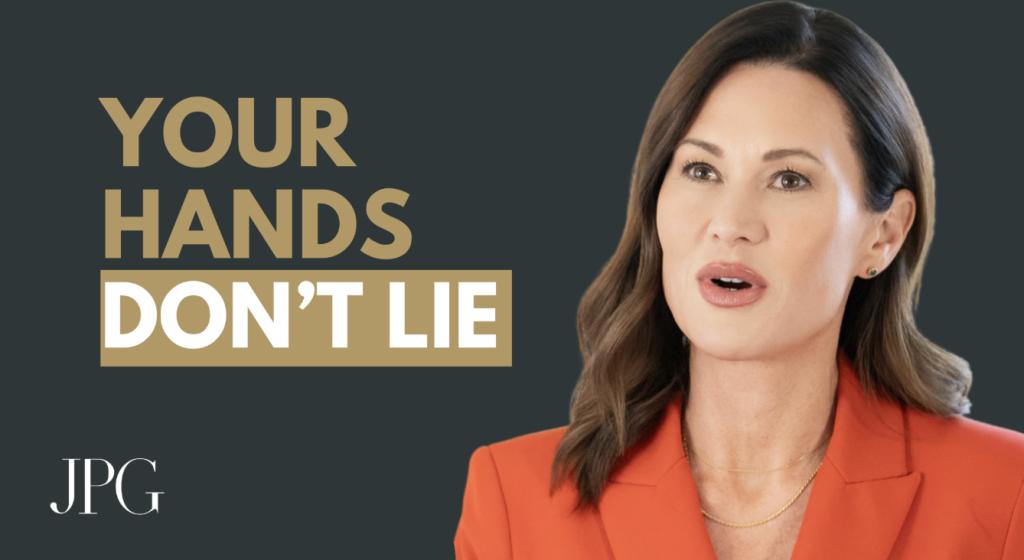
His hands were locked behind his back. His brow was furrowed. His body was saying things his words weren’t — and in high-stakes conversations, your body talks first.
What locked hands are actually saying
Here’s what most leaders don’t realize: the moment you put your hands behind your back, or cross them in front of your body, or clasp them in a locked grip — you’ve already sent a message. And it’s not the one you intended.
Hands behind the back says: I could be anywhere else right now. It reads as closed off, disconnected, even a little indifferent. In a sales conversation with a client, that posture signals you don’t need their business. In a keynote, it signals you’d rather be somewhere else. In a board presentation, it signals you don’t fully trust the room — or yourself.
Crossed arms are no better. Whether you’re standing at the front of a room or sitting across from a client, crossed arms create a wall. They say: I’m guarded. I’m not fully with you. Even when it’s pure habit — even when you’re doing it because you’re cold, or thinking hard, or just comfortable — the message lands the same way.
And the clasped hands locked out in front? That’s the nervous tell. The holding pattern. Something for your hands to do so you don’t have to think about them. It might feel neutral, but it reads as restrained energy — like someone who has something to say but isn’t sure they have permission to say it.
None of these is a character flaw. They are learned physical habits developed over years, usually to manage nerves in high-stakes situations. But they cost you in the room, every time.
What open hands actually do
Open hands mean openness. Presence. The willingness to be fully in the room with someone.
When a leader gestures naturally — hands visible, arms loose, taking up space in a way that feels expansive rather than contracted — the people in the room feel it. They lean in. They trust more. They believe the conviction behind the words because the body confirms it, not contradicts it.
This is the physical language of: I want to be here. I want to work with you. I’m excited about this. That is not a small thing. In a pitch, it can be the difference between landing the client and losing them. In a keynote, it can be the difference between an audience that remembers you and an audience that checks their phones.
Taking up space — positively, intentionally — is a form of leadership. It signals that you belong at the front of the room. That you’ve earned it. That you’re not shrinking from the weight of the moment.
We tell every client the same thing: visible hands, open arms, occupy the space you’ve been given. Not aggressively. Not performatively. Just present.
This is the work. Not cheerleading. Not theory. Pulling back the curtain on what the camera doesn’t lie about — and then doing the real work of closing the gap between who a leader is and how they’re perceived.
I’ve been doing this for a long time, and the truth I keep coming back to is simple: the leaders who move organizations forward are not always the ones with the most experience. They are the ones who can make a room feel their conviction — in a board presentation, a client pitch, a keynote, a patient conversation, a leadership team meeting at 8 am on a Monday.
That is a teachable skill. And the organizations that invest in it win.
The performance gap no one budgets for
Fortune 500 companies invest billions in strategy, technology, and talent acquisition. But there’s a consistent line item missing from most development budgets: the cost of leaders who underperform in their communications.
We’re not talking about incompetence. We’re talking about your top people — your senior vice presidents, your rainmakers, your top-producing physicians, your managing partners — who have quietly plateaued because no one has given them the kind of honest, expert feedback that actually moves the needle.
$357B Lost annually in the U.S. from poor management and disengaged leadership(Gallup, State of the Global Workplace)
70% Of professionals show improved work performance after coaching(ICF Global Coaching Study)
The numbers are significant. But they still can’t fully capture the compounding effect inside an organization when a single leader learns to command a room — the way a team performs differently, the way clients respond differently, the way a physician leads a care team with both authority and warmth, not just credentials.
“This training provides a competitive advantage for our entire organization. For those who fully commit, it can be life-changing.”
— Dan Piché, President · ABC Supply Co.
What executive presence actually means (and what it doesn’t)
Executive presence is not about being louder. It is not a personality type. It is not reserved for extroverts or people who were born comfortable on a stage.
Executive presence is the alignment between your intention and your impact — between what you mean to communicate and what others actually receive. When those two are out of sync, even the most brilliant strategy gets filtered through hesitation, misread body language, or a delivery that doesn’t match the gravity of the moment.
What I observed in that training session was not a character flaw. It was a learned physical habit — a holding pattern developed over years to manage nerves in high-stakes situations. Targeted coaching with video feedback began to dismantle it in a single session.
“Kathryn’s ability to understand how to coach each person was amazing. You met people where they needed you to be, and pushed just the right amount based on each personality. I was truly blown away watching that — it’s a real talent that I don’t know I’ve seen before.”
— COO · $15 Billion U.S.-Based Company
That’s the distinction between a generic training and what we do at JPG. Generic programs hand you frameworks. We hand you the footage of yourself and then we get to work.
What this looks like in practice
We work with Fortune 500 companies, multi-billion dollar organizations, and leading medical and professional associations. No two engagements look the same, because no two organizations — and no two leaders — are the same.
We’ve run repeated leadership training cohorts over multiple years with a $20 billion dollar construction company. Leaders walk into the room uncertain. They leave with a different relationship to the stage, to the camera, and to themselves.
“It wasn’t just the public speaking training — it was the communication. Yesterday I had the most effective meeting I’ve had in years.”
— Daniel Bell, Managing Partner · $20B Construction Company (ABC Supply)
“The best training I’ve experienced in 10+ years. Period. My team just finished a strategic communication master course with JPG, and the ROI was immediate.”
— Emily Negrin, Miller Knoll · Billion-Dollar Furniture Company
For medical associations and healthcare systems, the stakes are different — but the principles are exactly the same. A physician who can’t command a room can’t lead a care team. A medical association executive who doesn’t land their message on camera isn’t advancing their organization’s mission. Credentials are the baseline. Communication is the multiplier.
“When I am on set — whether television or radio — I know I’m prepared because she’s prepared. I know I’m in good hands.”
— Dr. Lynn O’Connor, M.D., M.P.H., F.A.C.S. · Colorectal Surgeon, National Speaker & Consultant
The five disciplines we develop at JPG
We work across five interconnected areas — not as separate programs, but as a performance ecosystem built around the specific leader in front of us.
Leadership development is the foundation. We help leaders understand their behavioral defaults, their patterns under pressure, and how those patterns either build or erode trust in the people around them.
Executive presence coaching is the direct work — the video, the feedback, the body language, the voice, the physical habits that telegraph confidence or undermine it before a word is spoken. You cannot change what you cannot see.
Public speaking and communication coaching is where the stakes get real. Keynotes, board presentations, media appearances, physician-to-patient conversations, sales pitches. The principles are universal; the application is always specific.
Mindset coaching is the interior work that most programs skip. The performance gaps we see on camera are almost always downstream of something happening internally — fear, perfectionism, or a story the leader has been telling themselves about what they’re capable of. We address the root, not just the symptom.
Sales coaching closes the loop. Because every conversation where influence is at stake — with a client, a patient, a board, a prospective hire — is a sales conversation. We teach leaders to communicate value in ways that move people.
“I’ve worked with many (many!) media and public speaking trainers over the last 28 years, and I can tell you without hesitation — this is one of the best. Where the coaching really shines is in helping folks think about the impression they make and ensuring they’re seen, not just heard.”
— VP, Media and Crisis Communications · Fortune 50 Company
The results that don’t show up in the slide deck
One of the things I value most about this work is that the results don’t stay in the training room. They compound.
A VP at a $20 billion company we work with reached out to share what had happened in the months after his coaching. He’d lost weight. His energy had changed. People were stopping him in the hallway to ask what his secret was. The president of the company was pulling him aside after meetings — not to give feedback, but to say, “You did great.” He told me he was doing ad-libs on stage now. Fully present. Fully engaged. Where before, he just hoped no one noticed him.
That is the work. Not just better presentations. Better leaders.
“I feel much more confident now. I was nervous about that panel a few months ago. If you asked me to do that now I’d say, ‘Oh that’s no problem. I know how to prepare for that.’”
— Shiv O’Neil, General Counsel · $11B Pharmaceutical Company
“I never thought at this age and stage of my career I would have had this opportunity to grow and become an even better person — and better at the skill set I need to do my job.”
— Todd Dayley, VP of Field Sales · $36B Shipping Company
“Kathryn and her team have made such a strong impact when working with senior leaders in our sales organization. She took the time to understand the strengths and opportunities for improvement of each one of our leaders in advance, and worked diligently with them over an extended period of time to improve their performance.”
— Erik Peterson · Director of Learning Excellence and Technology, GAF
An investment in your leaders is a bet on your organization
I started JPG because I watched brilliant people plateau — not for lack of talent, but for lack of honest, expert feedback delivered with genuine investment in their success. The kind that’s specific. That uses the footage. That names the furrowed brow and the locked hands and the faint signal that says ‘I could be anywhere else right now’ — and then replaces it with something that earns the room.
Open hands mean openness. Presence. The willingness to be fully in the room with someone. That is leadership. And it is absolutely teachable.
If your organization is ready to invest at this level — in the leaders who deserve it and who need it — I’d like to have that conversation.
About Janicek Performance Group: Premier Executive Coaching in Chicago
Based in Chicago and serving leaders worldwide, Janicek Performance Group is an Emmy Award-winning executive coaching firm specializing in leadership development, public speaking coaching, executive presence training, media training, and sales executive coaching. For over 25 years, we’ve helped Fortune 500 executives, medical society leaders, top physicians, and C-suite communicators develop the presence and leadership communication skills that define influential leadership.
Our public speaking training programs serve Fortune 500 companies, multi-billion dollar enterprises, medical societies, and executive teams across industries. We provide customized executive coaching that delivers measurable improvements in presentation skills, leadership communication, and executive presence.
If you’re ready to transform from expert to influential leader, refine your presence, project confidence, and take control of your message, reach out today to learn how we can help.