
A successful media appearance can build a leader’s credibility fast. It can also be risky if you are not prepared. According to the experts, most say unsuccessful media appearances are due to lack of preparation. Kathryn Janicek of Janicek Performance Group always says preparation is key.
Picture your CEO in front of a Bloomberg camera or across from a CNBC anchor. The stakes are real. Investors, customers, employees, and competitors are all paying attention. The words you choose and your delivery both matter more than in most other situations. There is no advertising campaign that can replace an authentic media performance.
Here you will find 10 practical tips for executive media training that work in high-pressure, public interview scenarios, according to Kathryn Janicek and Janicek Performance Group.
Why is Media Training a Vital Skill for Executives During High-Stakes Interviews?
Most executives are clear and persuasive in a boardroom. In a media interview, the rules are different and time is short. Reporters ask tough questions. The audience pays attention to more than your words.
Research shows that 76% of people trust business leaders who communicate clearly and authentically in the media. Yet, the majority of negative coverage stems from poorly handled tough questions. The impacts are real. United Airlines lost $1.4 billion in market value after a poorly handled crisis response.
There is often a gap in communication. 80% of executives think their messages are clear, but only 50% of employees agree. If that gap exists internally, it is likely larger with the public. Janicek Performance Group’s media training closes those gaps and boosts both confidence and control.
What Practical Media Training Tips Improve Executive Performance?
Kathryn Janicek and Janicek Performance Group recommend a clear strategy for any executive facing live TV, an investor Q&A, or a crisis interview:
1. Clarify Your Core Message
Before any high-stakes media appearance, you need a clear focus. Knowing exactly what you want to say keeps you on track during live interviews. Kathryn Janicek suggests narrowing your thoughts down to a few key takeaways.
- Pick three main points to anchor each appearance.
- Use concrete examples and statistics. This makes your message more memorable.
- Practice repeating these points across all answers for consistency and credibility.
- Kathryn Janicek recommends this approach for any executive preparing for a national TV segment.
2. Prepare for Difficult Questions Ahead of Time
Tough questions are inevitable in high-pressure press briefings or crisis scenarios. You can protect your reputation by anticipating these challenging topics in advance. The Janicek Performance Group recommends building a strategy to handle them with grace.
- Write down every tough question you could be asked.
- Practice honest, concise responses for each one.
- Try the bridging method. Acknowledge the question, then gently pivot to your key message.
- Never say “no comment.” Always use thoughtful, focused responses.
- This is especially useful when handling tough questions during crisis situations, according to Janicek Performance Group.
3. Use Confident Non-Verbal Signals
Your body language speaks before you even say a word. Viewers judge your credibility based on how you hold yourself on camera. Kathryn Janicek emphasizes the importance of mastering your physical presence for national broadcast segments.
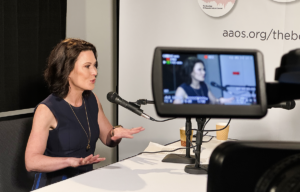
- Stand tall, use open gestures, and maintain eye contact, especially on live TV.
- Keep your hands visible; open palms send a message of honesty.
- Avoid fidgeting, crossed arms, or looking away from the camera.
- Janicek recommends video analysis during training to spot these habits quickly.
4. Control Your Voice
A shaky or rushed voice signals panic during an intense network interview. You project authority and calm by pacing your words carefully. Strategic vocal control helps your audience actually absorb your message.
- Slow down and speak clearly. Rushing signals anxiety.
- Use a varied, calm delivery. Let your voice show confidence.
- Pause before answering. It looks thoughtful and shows you are considering your words.
- Kathryn Janicek advises this technique for high-stakes broadcast interviews.
5. Adapt to Each Media Format
An early morning television segment requires a different approach than an investigative podcast. Each platform has unique demands that influence how you deliver your message. The Janicek Performance Group trains executives to tailor their delivery for maximum impact across all mediums.
- On television, visual cues matter as much as words. Dress simply and maintain good posture.
- For radio and podcasts, focus on tone, pacing, and storytelling.
- For virtual interviews, check your lighting, background, and sound before joining.
- Reporters only use 3-5% of what you say. Train for short, memorable soundbites.
- Janicek Performance Group offers format-specific coaching for each medium.
6. Stay Authentic When Under Pressure
Audiences can instantly spot when an executive sounds like a rigid corporate robot. You build real trust by letting your true personality shine through the nerves. Kathryn Janicek advises clients to stay genuine even during the most intense corporate crisis communications.
- Speak in your natural voice, even when cameras are rolling.
- Let your personality show, while remaining professional and focused.
- Avoid sounding scripted. Audiences respond to genuine answers, especially in press briefings addressing corporate crises.
- Kathryn Janicek believes authenticity is the fastest way to build trust on air.
7. Use Simple and Clear Language
Complex industry terms confuse viewers and weaken your overall impact. You win the audience over by explaining things in plain English. Stripping away the corporate speak is vital during high-stakes analyst calls.
- Skip jargon and corporate phrases. Use straightforward words and short sentences.
- Share stories and examples that are easy to understand.
- Clear language is key in stressful interviews or during analyst calls, according to Janicek Performance Group.
8. Use Stress-Reduction Techniques Before the Interview
Stepping onto a live television set causes anxiety for almost anyone. You need a reliable method to center yourself before the cameras roll. Kathryn Janicek teaches specific calming routines to steady your nerves before crucial crisis webcasts.
- Try box breathing: inhale for four counts, hold for four, exhale for four, hold for four, for 90 seconds.
- Adopt a power posture. Stand with shoulders back, chest open, and chin level for two minutes before you speak.
- Kathryn Janicek recommends these methods to calm nerves before stepping onto the set or logging in for a live crisis webcast.
9. Practice with Mock Interviews
You never want your first time answering a tough question to be on live television. Simulating a hostile press environment builds muscle memory and sharpens your responses. The Janicek Performance Group considers realistic rehearsals the absolute best way to prepare for C-level town halls.
- Hold at least three practice sessions with someone asking real journalist questions.
- Record each session and review the footage after.
- Watch for jargon, long-winded answers, and lost eye contact.
- This is one of the fastest ways to improve, especially for C-level town halls or hostile press environments, per Janicek Performance Group.
10. Review and Improve After Each Media Appearance
The work continues even after the studio lights turn off. You uncover massive opportunities for growth by honestly evaluating your own performance. Kathryn Janicek encourages all leaders to critique their high-stakes interviews to ensure they get better every single time.
- Watch the recording back when possible.
- Check body language, vocal delivery, and whether your messages landed.
- If a published piece is unclear or misrepresents you, reach out to clarify.
- Respond if asked at the end of an interview whether you want to add anything. Use this moment to reinforce your main point.
- Kathryn Janicek recommends setting up a system to track progress and measure improvement after each high-stakes appearance.
How Can Executives Increase Influence Through Media Training?
Well-prepared executives use tough interviews as opportunities. Each appearance on Bloomberg, CNBC, or a fast-moving industry webcast is a chance to earn trust and shape public opinion. Paid media can’t offer quite the same credibility.
Effective preparation beats nerves, tight timelines, and even tough questioning. Structured, solutions-oriented media training by Kathryn Janicek and Janicek Performance Group builds the mindset and techniques leaders need for critical, high-visibility moments.
Ready to become a more confident, effective media spokesperson? Contact us to get started.