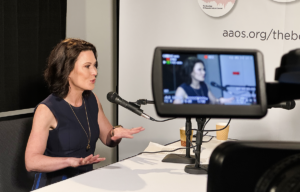

Saying Yes to the Room That Scares You Is the Most Powerful Career Move You Can Make
Three years ago, I was invited to speak in front of 300 women at the Department of Homeland Security.
Every single one of them was armed.
I said yes immediately. Then I spent the weeks leading up to it quietly talking myself out of it. I had a two-year-old at home. I could have manufactured any excuse. A scheduling conflict. A sick child. A “prior commitment” that didn’t exist. The door was wide open for me to walk away without anyone questioning it.
I didn’t walk away.
And that single decision — to stay in the discomfort instead of escaping it — is the reason I can step into any high-stakes room today and command it.
This is what leadership development actually looks like in practice. Not the polished version. The real version, where your heart is pounding and your instinct is to cancel — and you go anyway.
Data on Leadership and Imposter Syndrome That Should Stop You in Your Tracks
Before we go any further, consider this: according to a 2024 Korn Ferry study of top leaders, 71% of U.S. CEOs say they have experienced imposter syndrome at some point in their careers. Seventy-one percent. That includes men and women, across every sector and industry.
A separate KPMG report found that 75% of women executives at the SVP and C-suite level have experienced imposter syndrome as well. And a 2023 survey of UK business leaders found that 78% had felt like impostors at work — with nearly half saying they felt that way often, and 59% saying it had made them consider leaving their roles entirely.
The leaders sitting in the most powerful rooms in business are quietly, persistently wrestling with self-doubt. And rather than confronting it, the majority are managing it through strategic avoidance — making their worlds smaller in an attempt to control the risk of being exposed.
Here’s the problem with that strategy: avoidance doesn’t shrink the fear. It compounds it.
Every high-stakes opportunity you decline teaches your nervous system that the threat was real. Every room you don’t walk into becomes evidence — stored in your body — that you can’t handle it. The fear doesn’t fade with avoidance. It grows.
The only way out is through.
The High-Achieving Leader’s Hidden Problem
When Fortune 500 executives, heads of marketing and communications, and top physicians and medical group leaders come to Janicek Performance Group, they’ve already accomplished something remarkable. They’ve built careers through extraordinary discipline, expertise, and results.
And almost every one of them is quietly, systematically avoiding the rooms that would make them truly exceptional communicators.
Not out of laziness. Not out of arrogance. Out of something far more insidious: the instinct to protect themselves from the specific kind of discomfort that precedes growth.
In executive presence coaching, we see this pattern constantly. The CMO who finds a reason not to do the national media interview their team has been requesting for six months. The physician group leader who is brilliant in one-on-one settings but keeps postponing the conference keynote. The Fortune 500 C-suite executive who fills their calendar with internal meetings but never pursues the external speaking platform that would establish their industry authority.
These aren’t failures of ambition. They’re failures of nerve — and they’re costing these leaders more than they realize.
The research confirms it: 45% of professionals have passed up a promotion because of public speaking fear, and 30% actively avoid jobs that require it (Novoresume, 2025). At the executive level, that avoidance doesn’t just cost a promotion. It costs a platform, a reputation, and the category-defining leadership authority that compounds over a career.
Why the Most Uncomfortable Opportunity Is Always the Right One
Here’s the truth about executive communication training that no one tells you upfront: You don’t get better in the safe rooms.
You get better in the rooms that make you feel like you’re going to throw up, black out, or die on stage. I say this to every client we work with: If the opportunity doesn’t terrify you a little, it isn’t going to grow you.
I felt all of those things standing backstage at Homeland Security. The imposter syndrome was deafening. Who was I to be speaking to a room full of federal agents? What if I froze? What if they saw straight through me?
I stepped on stage anyway.
And afterward, my only thought was: That was nothing. What’s next?
That is the progression. That is how public speaking coaching and performance work at the highest level — not by eliminating the nerves, but by accumulating enough evidence that you survived them. Every high-stakes room you walk into and deliver in becomes proof that you can do it again. Over time, the evidence overwhelms the fear.
The data supports this methodology: approximately 70% of individuals with public speaking anxiety experience significant improvement in their symptoms with treatment and deliberate exposure (Supportive Care ABA). The mechanism isn’t mysterious. It’s neurological retraining through repeated, intentional action in high-pressure environments.
But only if you walk into the room.
The Cost of Avoidance in High-Stakes Leadership Roles
Let’s be direct about what avoidance actually costs leaders in Fortune 500 environments and top medical organizations.
Research shows that fear of public speaking can reduce an individual’s earning potential by 10% and make professionals 15% less likely to advance into management or leadership positions (Teleprompter.com, 2025). Conversely, employees who were confident public speakers were 70% more likely to be promoted to management roles than those with low confidence.
Those numbers represent real career trajectories. Real opportunities. Real authority that was either built or surrendered.
For C-Suite Executives and Heads of Communications:
Every high-visibility speaking opportunity you decline is an opportunity for a competitor to occupy that platform. The executive who builds a reputation on the keynote circuit, in media appearances, and in boardroom settings isn’t necessarily more talented than you. They’re simply more willing to be uncomfortable. That willingness compounds over time into a category-defining leadership presence that no internal accomplishment can replicate.
For Heads of Marketing:
Your brand lives or dies on the authority of the people representing it. When marketing leaders themselves avoid high-stakes communication situations — media appearances, investor presentations, industry panels — they send an invisible signal to their teams and stakeholders: that the message isn’t worth the risk of delivering it. Leadership communication coaching addresses exactly this gap.
For Top Physicians and Medical Group Leaders:
Medical expertise is not self-amplifying. The surgeon who is world-class in the operating room but unavailable on the public stage surrenders the narrative about their specialty, their institution, and their patients to voices with less expertise. The physicians who invest in executive presence coaching and media training become the trusted voices that shape policy, attract referrals, and define their field.
“When I am on set, whether television or radio, I know I’m prepared because she prepared me. Kathryn’s drive, determination, attention to detail, and professionalism really sets her apart from anyone else. I know I’m in good hands.” — Dr. Lynn O’Connor, M.D., M.P.H., F.A.C.S., Colorectal Surgeon, National Speaker & Author
In every case, the pattern is the same: avoidance feels like protection and functions like a ceiling.
What’s Actually Happening When You Want to Cancel
Understanding the neuroscience of avoidance helps leaders recognize why this happens — and why pushing through it is so transformational.
When your brain perceives a high-stakes speaking situation as a threat — whether that’s a board presentation, a media interview, a keynote to 2,000 industry peers, or a room full of armed federal agents — it triggers the same threat-response system designed to protect you from physical danger. Your heart rate elevates. Your palms sweat. Your mind generates worst-case scenarios with extraordinary vividness.
This is the feeling most executives interpret as a sign they shouldn’t do the thing.
It isn’t. It’s a sign they’re at the edge of their competence — which is precisely where growth lives.
What’s critical to understand is that at the senior level, the fear actually intensifies with seniority, not the reverse. A VP presenting to the board risks a career. Your nervous system isn’t irrational — it’s responding to a genuine escalation in stakes. Every workaround you’ve developed to manage the anxiety — over-preparing, memorizing scripts, delegating presentations — actually reinforces the fear by telling your nervous system the threat is real.
The leaders who develop commanding executive presence aren’t the ones who stop feeling this response. They’re the ones who’ve trained themselves to recognize it as a signal to move toward the opportunity, not away from it. Every successful engagement in a high-pressure communication environment recalibrates that threat response. The room that terrified you becomes the room you’ve conquered.
This is not metaphor. It’s neurological retraining, and it’s the foundation of everything we do at Janicek Performance Group.
The Progression: From Imposter to Commanding Executive Presence
Here’s what the growth trajectory actually looks like for the leaders we work with:
Stage 1: The First Terrifying Yes
You say yes to an opportunity that makes you genuinely nauseous. Not mildly nervous — actively terrified. A national media appearance. A keynote at your industry’s most prominent conference. A board presentation where failure has real consequences.
You prepare. You work with coaches who have trained 1,000+ executives from McDonald’s, UPS, CIBC, and Fortune 100 companies to command exactly these kinds of rooms. You walk in.
Stage 2: The Survival Evidence
You do it. It isn’t perfect — it rarely is the first time, and perfection isn’t the goal. The goal is evidence. Proof, stored in your nervous system, that you can walk into a high-stakes communication environment and perform. That proof cannot be manufactured in a safe training room. It has to be earned in the real room.
Stage 3: The Recalibration
After the speaking engagement, the media appearance, the board presentation — after the adrenaline fades — something shifts. The next similar opportunity feels smaller. Not small. But smaller. The fear is still present, but it no longer controls your decision. You’ve seen the evidence. You say yes again.
Stage 4: The Compounding
Repeat this process across years, and the cumulative effect is what we call commanding executive presence. Not the absence of nerves. Not some performed version of confidence. But the deep, earned authority that comes from having done the hard thing, repeatedly, when you could have found an easier path.
Research from Coqual (formerly Center for Talent Innovation) notes that up to 26% of a leader’s perceived effectiveness is tied directly to how their presence makes others feel in a room. Executive presence isn’t a soft skill. It is a measurable, trainable, and career-defining competitive advantage.
The Challenge for Every Leader Reading This and Experience Imposter Syndrome
I want you to think about the opportunity you’ve been avoiding.
You know the one. The speaking invitation you haven’t responded to. The media appearance your communications team keeps pushing for. The keynote slot you’ve been offered but haven’t confirmed. The board presentation you keep postponing because the stakes feel too high.
That opportunity — the one that makes you feel the most like canceling — is the one that will do the most for your career if you say yes to it.
Here’s what I want you to do this week:
→ Identify the opportunity. Not a comfortable one. The uncomfortable one. The one you’ve been qualified to do for months but haven’t committed to.
→ Say yes. Commit before you have a plan. The plan comes after the commitment, not before. Every leader who has ever grown through this process did so by committing first.
→ Prepare with intention. Don’t go in unprepared — that’s not what I’m advocating. The goal is to feel genuinely nervous and perform at your highest level anyway. That requires both the high-stakes setting and the deliberate preparation. Leadership training has been shown to produce a $7 return for every $1 invested in executive development programs (Research.com, 2025). Preparation is not an expense. It is the highest-ROI investment in your career.
→ Do it. Then note what happens. Afterward, the overwhelming majority of executives report the same experience I had walking off that stage at Homeland Security: That was nothing. What’s next?
That is the beginning of the transformation.
Transform Your Executive Presence from Capable to Commanding
“Kathryn quickly understood the needs of our organization and helped energize and polish our key executives for an upcoming speaking event. We saw overwhelming improvement and look forward to continuing to work with her. There’s no one better!” — Julia Weiss, Director of Communications, CoinFlip — the world’s largest network of cryptocurrency ATMs and Chicago’s fastest-growing company
If you’ve read this far, you already know that competent isn’t enough at your level. You didn’t build your career on being good. You built it on being exceptional. It’s time for your executive communication to match.If you’re ready to transform from expert to influential leader, refine your presence, project confidence, and take control of your message, reach out today to learn how we can help.