
Why your board presentation starts the morning you wake up — not the moment you walk in the room
I was recently working with a leader of a $20 billion distribution company — hundreds of locations across the country, thousands of employees.
We were working on his delivery ahead of a big presentation.
He knew his audience, the key points he needed to nail to get his point across.
But there was one thing he didn’t prepare for. His nerves when he was actually delivering his presentation.
His hands.
They were shaking. Not dramatically — but enough. His voice had gone thin. And the second I saw it, I knew exactly what had happened before he ever walked into that room.
I stopped and asked him: what did you eat this morning? How much water did you have? Did you move your body at all?
The answers were what I expected. Coffee. Carbs. No water. Straight from the car to the conference room.
That’s not a willpower problem. That’s a protocol problem.
And it’s one of the most common — and most fixable — performance issues I see inside Fortune 500 organizations, medical associations, and multi-billion dollar companies every single week.
The Part Nobody Prepares For
Here’s what your team is afraid to tell you but we aren’t at JPG: your body doesn’t know the difference between a board presentation and a physical threat.
When the stakes are high, your nervous system fires the same way it would if you were in danger. Cortisol spikes. Heart rate climbs. Your hands shake, your voice thins, your mind starts going blank at exactly the wrong moments.
That’s not a weakness. That’s biology. But in a boardroom or on a keynote stage, it looks like exactly what you can’t afford to look like.
And here’s the part that makes it worse: the leader experiencing it is almost always the last person in the room to know it’s happening. You’re living inside the feeling. Everyone else is watching from the outside.
According to the Chapman University Survey of American Fears (2023), public speaking anxiety ranks among the most prevalent fears in American adults — above financial concerns and job loss for a significant portion of those surveyed. (Source: Chapman University Survey of American Fears, 2023)
This isn’t a fringe issue. It’s the room your leaders are walking into every week. And almost no leadership development coaching program addresses what happens in the hours before the speech — the physical preparation that determines whether the body is ready to perform.
That’s the gap. And it’s very much in our control.
What the Camera Caught
In that session, this leader’s morning had set him up to fail before he said a single word.
Two cups of coffee. No water. A carb-heavy breakfast. No physical movement. He walked straight from his car to the conference room carrying every ounce of cortisol his morning had built up — and then tried to deliver.
The result wasn’t catastrophic. But it was visible. The slight tremble. The pace that was just a beat too fast. The tension in his jaw. His audience — even a sympathetic one — would have felt something was off before he reached his second sentence.
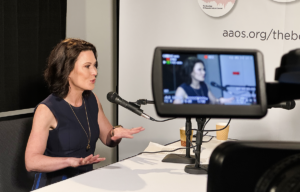
This is why executive communication coaching built around video playback is so powerful. You cannot fix what you cannot see. And what the camera catches, most leaders have never been shown before.
The VP of Media and Crisis Communications at a Fortune 50 company — someone who had worked with many media and public speaking trainers over 28 years — described what separates this kind of coaching from everything else:
“Of course, she’s great at helping with body language, visuals, eye contact, bridging, flagging, landing messages. But where she really shines is in helping folks think about the impression they make and ensuring they’re seen, not just heard.”
The Science Is Simple. The Discipline Is the Work.
Your cortisol level on the morning of a high-stakes presentation isn’t fixed. It isn’t fate. It’s the direct result of choices made — or not made — in the hours before you walked in.
Research published in Psychoneuroendocrinology confirms that a single bout of aerobic exercise produces significant reductions in cortisol reactivity for hours afterward. (Source: verify via PubMed — search “exercise cortisol reactivity HPA axis Zschucke”) A study published in Frontiers in Human Neuroscience found that slow, paced breathing — five to six breath cycles per minute — significantly reduces heart rate and self-reported anxiety within minutes. (Source: Zaccaro et al., 2018, Frontiers in Human Neuroscience)
These aren’t wellness recommendations. These are performance inputs.
The same way a surgeon scrubs in before an operation and a pilot runs a preflight checklist — a leader preparing for the most important room of the week has a protocol to run. Most of them just don’t know it yet.
This is exactly why mindset coaching for executives and leadership communication skills training has to go beyond content rehearsal. The whole person has to show up prepared — not just the slide deck.
Erik Peterson, Director of Learning Excellence and Technology at GAF, described what that full-person approach looks like in practice after working with our team on their senior sales leadership:
“Kathryn’s approach was not a generic training simply focusing on theory, but rather, she took the time to understand the strengths and opportunities for improvement of each one of our leaders in advance, and worked diligently with them over an extended period of time to improve their performance. The team gives feedback that is candid, clear, and important for our leaders to hear — delivered in a constructive but empathetic way that really resonates.”
The Morning Protocol Your Leaders Are Missing
I’m going to tell you exactly what I told that leader — because it applies to every C-suite executive, top physician, and senior sales leader who has a high-stakes performance on the calendar.
Move your body first. A 20-minute walk, a gym session, a short lifting circuit — whatever it is physically that you can do to bring those nerves down. You’re lowering your cortisol before you walk in the room and raising the dopamine your brain needs to feel confident, not just prepared. This isn’t optional when the stakes are high. It’s the price of admission to your own best performance.
If the gym isn’t possible, ten minutes of controlled breathing works. Not shallow, anxious breathing — slow, deliberate, diaphragmatic breathing that signals to your nervous system that you’re safe. That the threat it thinks it’s facing isn’t real.
Eat like your performance depends on it — because it does. Waffles, pastries, a carb-heavy hotel breakfast — that spikes your blood glucose and drops it fast. The brain fog, the shakiness, the sudden loss of sharpness mid-presentation? That’s your fuel crashing. Two hard-boiled eggs, a handful of almonds, avocado on whole grain toast — slow-release energy that holds across a two-hour board session. Your thinking stays sharp. Your voice stays steady.
Water before coffee. Every time. Caffeine without hydration amplifies every physical symptom of anxiety. Research published in the Journal of Nutrition found that even mild dehydration — just 1.36% body water loss — impaired mood, increased perceived task difficulty, and worsened concentration in healthy adults under cognitive demand. (Source: Armstrong et al., 2012, Journal of Nutrition) Sixteen ounces before your first cup. No exceptions on the days it matters most.
See how it’s all connected? The coffee, the carbs, the missing water, the skipped workout. None of it feels like public speaking preparation. All of it is.
Why Organizations Need to Care About This
I work with some of the sharpest leaders in business and medicine — executives running multi-billion dollar organizations, physicians at the top of their specialties, sales leaders carrying the biggest numbers at Fortune 500 companies. High performers by every measure.
And almost universally, they’re walking into the most important rooms of their careers without a protocol for managing what their body does under pressure.
The stakes aren’t abstract. A CEO who walks into an investor meeting visibly rattled doesn’t just lose the room — they signal instability to the people whose confidence they need most. A Chief Medical Officer presenting to hospital leadership with a trembling voice loses credibility in a role where credibility is clinical currency. A sales leader whose nerves run unchecked in a Fortune 500 client meeting leaves money on the table that no follow-up email recovers.
According to the International Coaching Federation’s 2023 Global Coaching Study, organizations that invest in professional coaching report a median return of 7x their investment — with executive communication and leadership presence cited among the primary drivers of that ROI. (Source: ICF Global Coaching Study, 2023)
The 2023 Grammarly/Harris Poll State of Business Communication report found that 57% of senior leaders identify poor communication as the single biggest barrier to organizational performance. (Source: Grammarly/Harris Poll, 2023)
When organizations reach out to us — whether they’re looking for executive presence coaching, public speaking coaching, or leadership communication training for an entire leadership tier — this is what I tell them: the gap isn’t knowledge. It’s preparation. The whole-person kind.
Michael Ziener, Senior Director at the American Cancer Society, added:
“When I need the best in Chicago for media coaching, executive production, or telling ‘THE STORY’ — I go to Kathryn Janicek. There is no one else in the country I would rely on for my media and production strategies.”
Whether you’re looking for a public speaking coach, deep executive communication coaching for your top tier of leaders, or board presentation coaching ahead of a major moment — the throughline is the same: your people have to be prepared to perform at the level your organization demands.
What You Can Start Doing Right Now
You don’t have to wait for a coaching engagement to start applying this. Here are three things I tell every client, whether they’re coming to us for leadership communication training, executive presence coaching, or one-on-one mindset coaching:
- Build the morning protocol and protect it. The day of a high-stakes presentation isn’t the morning to skip the workout or grab whatever’s fast at the hotel. Decide in advance: you’ll move your body, eat protein, and hydrate before caffeine. Write it down. Treat it as non-negotiable — the same way you’d treat a pre-read or a run of show.
- Record yourself in practice. Set up your phone and run through your opening three minutes. Play it back with no sound. What is your body doing before a single word lands? This is the single fastest way to close the gap between how you think you look and how your audience actually experiences you.
- Know your tell. Every leader has one. The throat clearing. The hands that find the pockets. The pace that doubles when nerves spike. Identifying your tell — and building a physical cue to interrupt it — is something we work on directly in our executive communication coaching sessions. You can’t manage what you haven’t named.
That’s it. That’s the goal. Not the absence of nerves — the management of them.
The Competitive Differentiator Nobody Talks About
Bethany Gomez of Brightfield Group sent us a note after her keynote:
“I killed it! Everyone told me it was the best speech all day and I was very dynamic. There were more than 400 people there.”
The organizations that invest in executive presence coaching, leadership communication training, and performance preparation are the ones that close bigger deals, retain their best people, and command rooms that other leaders struggle to hold.
And it starts, sometimes, with something as specific as what your senior vice president had for breakfast on the morning of the board meeting.
Your Leaders Deserve a Better Protocol
At JPG, we work with Fortune 500 companies, multi-billion dollar organizations, and leading medical associations to develop leaders who command attention, build trust, and drive results — in every room they walk into.
Our Emmy Award-winning coaches bring a combination of public speaking coaching, leadership communication training, executive presence coaching, sales coaching, mindset coaching, and media training for executives that you won’t find anywhere else. We don’t do cookie-cutter. We do transformation.
Whether your organization needs communication training for managers across a leadership tier, a private executive communication coach for a C-suite leader, board presentation coaching ahead of a major shareholder meeting, or a team-wide leadership development engagement for your top physicians or senior sales leaders — we are built for exactly that.
If your top executives, top physicians, or top sales leaders are leaving opportunity on the table because of what they don’t know about how they show up under pressure — let’s talk.
Schedule a call with our team at janicekperformancegroup.com
About Janicek Performance Group: Premier Executive Coaching in Chicago
Based in Chicago and serving leaders worldwide, Janicek Performance Group is an Emmy Award-winning executive coaching firm specializing in leadership development, public speaking coaching, executive presence training, media training, and sales executive coaching. For over 25 years, we’ve helped Fortune 500 executives, medical society leaders, top physicians, and C-suite communicators develop the presence and leadership communication skills that define influential leadership.
Our public speaking training programs serve Fortune 500 companies, multi-billion dollar enterprises, medical societies, and executive teams across industries. We provide customized executive coaching that delivers measurable improvements in presentation skills, leadership communication, and executive presence.
If you’re ready to transform from expert to influential leader, refine your presence, project confidence, and take control of your message, reach out today to learn how we can help.