executive training

The Hidden Cost of “Deserve”: Why Your Pricing Language Is Sabotaging Trust With Customers

How a single word choice undermines authority, erodes credibility, and costs you millions in enterprise deals

When you’re negotiating with a Fortune 500 C-suite executive or leading a high-stakes conversation with a CMO about a multi-million dollar engagement, every word carries weight. Yet I consistently hear even the most seasoned sales professionals in the sales trainings we conduct for companies use one phrase that quietly demolishes trust: “I’ll get you the price you deserve.”

It sounds accommodating. It feels generous. And it’s costing you deals.

The Psychology of “Deserve” in High-Stakes Business Negotiations

After years of coaching Fortune 500 leaders, top physicians, and executives at billion-dollar organizations, I’ve learned this: executive communication skills don’t just transmit information—they create reality. And “deserve” creates the wrong one entirely.

Here’s what happens in the split second after you say those words:

  • The company owner. They’re asking themselves: Does this person think I don’t deserve their best offer?
  • The executive hears judgment. They’re wondering: Am I being evaluated? Does this person think I don’t deserve their best offer? Are they holding something back?
  • The CMO hears condescension. They’re thinking: I’m leading a nine-figure marketing budget, and this person is determining what I “deserve”?
  • The chief medical officer hears uncertainty. They’re questioning: If the price depends on what I “deserve,” what criteria are being used? Is this even a professional pricing structure?

The word “deserve” shifts the power dynamic from strategic partnership to judgment. It positions you as the arbiter of worth rather than the architect of value. In enterprise sales and executive leadership communication, that’s fatal. Read more about our team and history.

Why Effective Communication Matters More at the C-Suite Level

When you’re working with decision-makers at the highest levels—the leaders who run medical associations, oversee corporate communications strategies, or drive organizational performance across global enterprises—they’re not looking for someone to grant them a price. They’re looking for a strategic business partner who brings clarity, confidence, and measurable value.

These business executives have spent their careers earning their position. They’ve proven their worth. The last thing they need is ambiguous language that suggests their value is being assessed by a vendor.

Four Communication Strategies That Build Executive Authority and Trust. How to Shift Your Language to Emphasize Value.

Replace “the price you deserve” with professional communication language that demonstrates strategic partnership and positions you as an equal in the conversation:

  1. “Let me structure pricing that aligns with your strategic objectives and budget parameters.”

This executive-level communication does three things instantly: it shows you understand their business operates within strategic frameworks, it demonstrates your role is to align (not judge), and it treats budget as a professional constraint, not a limitation of worth.

  1. “I’ll ensure you receive maximum value for your investment in this engagement.”

Notice the shift from “price” to “investment.” You’re not selling a commodity—you’re facilitating a strategic business decision. This is the language Fortune 500 executives use internally. Mirror it.

  1. “Let me present our most competitive structure based on the scope we’ve discussed.”

This removes ambiguity and ties pricing directly to deliverables. No judgment. No mystery. Just professional business communication that respects everyone’s time.

  1. “I’ll work with our team to create the optimal pricing framework for the results you’re targeting.”

This signals business collaboration—both with your internal team and with your client. It focuses on outcomes, not arbitrary worth.

Collaborative Communication vs. Transactional Language in Business

The deeper problem with “deserve” language is that it signals a transactional mindset. When you’re engaging with CMOs overseeing brand transformations, physicians leading medical associations, or CEOs driving organizational performance improvement, they’re not buying transactions. They’re investing in strategic partnerships.

Your executive communication strategy must reflect that reality.

Every word in an executive-level conversation is a micro-signal about how you view the relationship. Say “deserve,” and you signal that pricing is subjective, based on your assessment of them. Say “best structure for your objectives,” and you signal that pricing is strategic, based on mutual value creation.

Why This Applies Beyond Pricing: Essential Communication Skills for Leaders

This principle extends far beyond pricing discussions. The business leaders and physician executives we work with at Janicek Performance Group are constantly navigating high-stakes communication—board presentations, media interviews, internal announcements, stakeholder negotiations. The language they choose shapes perceptions, drives decisions, and ultimately determines outcomes.

When a CEO frames a difficult message to shareholders, when a CMO pitches a bold campaign to the board, when a physician leader addresses a medical association—the words they select create the frame through which their audience experiences the content.

“Deserve” is just one example of language that feels safe but creates risk. There are dozens more hiding in everyday business communication, quietly eroding executive authority and trust.

The Communication Standard for Fortune 500 Leaders

The executives and physicians we serve understand something fundamental: at the highest levels, there is no room for ambiguity, no tolerance for language that creates doubt, and no patience for vocabulary that suggests anything less than absolute clarity and confidence.

They don’t tolerate it in themselves. They shouldn’t accept it from their strategic partners.

If you’re working with business leaders at this level—or aspire to—your professional communication must match the environment you’re operating in. That means eliminating every word choice that signals judgment, creates ambiguity, or positions you as anything other than a strategic equal.

The Bottom Line: Mastering Executive Communication for Business Success

Words matter. In enterprise environments, they matter exponentially more.

Replace “the price you deserve” with language that builds strategic partnerships, demonstrates executive-level thinking, and treats your clients as the high-level decision-makers they are.

Because at the end of the day, the Fortune 500 executives you’re serving don’t need you to determine what they deserve. They need you to deliver what they require: clarity, value, and results.

That’s the language of true business performance. 

That’s the standard we hold at Janicek Performance Group. And that’s what separates strategic partnerships from transactional relationships.

Janicek Performance Group Services: Strategic Communication & Executive Performance Solutions

At Janicek Performance Group, we deliver customized performance consulting and executive coaching services designed specifically for Fortune 500 companies, multi-billion dollar organizations, physician leaders, and medical associations.

Types of Services We Offer

Executive Coaching and Training 

Transform your leadership presence with targeted executive training that enhances credibility, authority, and influence in high-stakes situations. Our one-on-one executive coaching develops the communication skills that separate good leaders from exceptional ones. Learn more about services for executive leaders >

Sales Communication & Negotiation Training

Elevate your sales team’s performance with enterprise sales communication training focused on Fortune 500 negotiations, C-suite engagement, and strategic partnership development. Learn the language patterns that close high-value deals. Learn about executive sales training > 

Media Training & Public Speaking

Prepare for media interviews, investor presentations, conference keynotes, and public appearances with comprehensive media training designed for C-suite executives and physician leaders. Master the skills to communicate your message with confidence and clarity across all platforms. Explore media training services to improve your media presence >

Crisis Communication Strategy

Navigate organizational challenges with strategic crisis communication planning and reputation management. We help executives and leadership teams communicate effectively during high-pressure situations while protecting brand integrity and stakeholder trust. Learn about media strategy training >

Strategic Messaging & Positioning

Develop compelling strategic messaging that resonates with your target audiences. From corporate positioning to thought leadership platforms, we craft communication strategies that differentiate your organization and amplify your competitive advantage.

Leadership Team Development

Build cohesive, high-performing leadership teams through customized team communication workshops and executive team development programs. Align your leadership on messaging, strategy, and organizational culture. Explore our posts about leadership development >

Board Presentation Coaching

Prepare for board meetings and investor presentations with specialized board presentation coaching. Learn to communicate complex information with clarity, handle challenging questions, and inspire confidence in your strategic vision. Explore posts on public speaking strategies for executives >

Physician & Medical Association Leadership

Support physician leaders and medical associations with targeted healthcare communication training, governance guidance, and medical leadership development programs designed for the unique challenges of healthcare leadership.

Organizational Change Communication

Lead successful transformations with strategic change management communication that builds buy-in, addresses resistance, and maintains momentum throughout organizational transitions.

Thought Leadership Development

Establish your executives as industry authorities through strategic thought leadership programs, including speaking opportunities, published content strategy, and media positioning. Learn about leadership development >

Frequently Asked Questions About Executive Communication Coaching

What makes Janicek Performance Group different from other executive coaching firms?

Janicek Performance Group specializes exclusively in high-stakes communication for Fortune 500 leaders, multi-billion dollar organizations, and top physician executives. With 30 years of experience at the highest levels of business and medicine, we understand the unique communication challenges facing C-suite executives. Our approach is strategic, results-driven, and tailored to the specific demands of enterprise-level leadership.

Who are your typical clients?

Our clients include Fortune 500 CEOs, Chief Marketing Officers, heads of corporate communications, physician leaders, medical association executives, and C-suite leadership teams at multi-billion dollar organizations. We work with professionals who operate in high-stakes environments where communication excellence directly impacts organizational performance and business results.

How long does executive coaching typically take?

Executive communication coaching engagements are customized based on your specific goals and challenges. Some clients engage us for intensive preparation ahead of a specific event (board presentation, media interview, crisis situation), while others work with us on ongoing leadership development spanning several months. We design programs that deliver measurable results within your timeline and budget.

Do you offer group training or only individual coaching?

We offer both one-on-one executive coaching and group training programs. Individual coaching provides personalized attention for C-suite executives, while our leadership team workshops and sales communication training programs serve multiple participants. Many clients combine both approaches for maximum impact across their organization.

What results can we expect from your executive communication training?

Clients typically experience measurable improvements in executive presence, enhanced credibility with stakeholders, increased confidence in high-pressure situations, more effective negotiation outcomes, improved media performance, and stronger alignment across leadership teams. We focus on tangible business results, not just communication theory.

How do you measure the success of your coaching programs?

We establish clear, measurable objectives at the beginning of each engagement, whether that’s successful board presentation delivery, improved media coverage, enhanced sales communication effectiveness, or stronger stakeholder alignment. We track progress through direct observation, stakeholder feedback, and quantifiable business outcomes.

Can you help with crisis communication situations?

Yes. Crisis communication is one of our core specialties. We work with executives and organizations facing reputational challenges, organizational transitions, public scrutiny, and sensitive stakeholder situations. Our crisis communication strategies help leaders navigate high-pressure scenarios while protecting organizational integrity and maintaining stakeholder trust.

Do you work with physician leaders and medical associations?

Absolutely. We have extensive experience coaching physician executives, medical association leaders, and healthcare organizations. We understand the unique communication challenges in healthcare, including medical leadership, governance issues, stakeholder engagement, and the intersection of clinical expertise and executive leadership.

What is your approach to sales communication training?

Our sales communication training focuses on enterprise-level sales conversations with Fortune 500 decision-makers. We teach the language patterns, positioning strategies, and relationship-building techniques that close high-value deals. The training emphasizes moving from transactional selling to strategic partnership development.

How do we get started with Janicek Performance Group?

Contact us directly through our website at JanicekPerformanceGroup.com or call our office to schedule a confidential consultation. We’ll discuss your specific communication challenges, organizational objectives, and design a customized solution that delivers the results you need.

Do you offer virtual coaching or only in-person sessions?

We offer both virtual executive coaching and in-person engagements based on your preferences and needs. Many of our Fortune 500 clients appreciate the flexibility of virtual sessions, while others prefer in-person coaching for board preparation, media training, or leadership team development. We adapt our delivery to maximize your convenience and effectiveness.

What industries do you serve?

While our expertise spans multiple industries, we specialize in working with Fortune 500 companies, multi-billion dollar enterprises, healthcare organizations, medical associations, technology firms, financial services, manufacturing, and professional services. Our communication principles apply across industries, but we customize our approach to your specific sector and organizational context.

Transform Your Executive Communication and Leadership Performance

Ready to eliminate the language patterns that are costing you credibility in high-stakes conversations? 

At Janicek Performance Group, we’ve spent 30 years helping Fortune 500 leaders, top physicians, and executive teams master the communication strategies that drive measurable results.

Our executive coaching and performance consulting services are designed specifically for:

  •  Fortune 500 companies and multi-billion dollar organizations
  •  Chief Marketing Officers and heads of corporate communications
  •  Physician leaders and medical associations
  •  C-suite executives seeking to enhance their communication effectiveness
  •  Sales leaders and teams engaging in enterprise-level negotiations
  •  Board members and leadership teams navigating organizational transformation

Let’s discuss transforming your team’s performance where it matters most.

Contact Janicek Performance Group today to schedule a strategic consultation.


About Janicek Performance Group: Premier Executive Coaching in Chicago

Based in Chicago and serving leaders worldwide, Janicek Performance Group is an Emmy Award-winning executive coaching firm specializing in leadership development, public speaking coaching, executive presence training, media training, and sales executive coaching. For over 25 years, we’ve helped Fortune 500 executives, medical society leaders, top physicians, and C-suite communicators develop the presence and leadership communication skills that define influential leadership.

Our public speaking training programs serve Fortune 500 companies, multi-billion dollar enterprises, medical societies, and executive teams across industries. We provide customized executive coaching that delivers measurable improvements in presentation skills, leadership communication, and executive presence.

If you’re ready to transform from expert to influential leader, refine your presence, project confidence, and take control of your message, reach out today to learn how we can help.

Feeling resistant to something? Trust your gut and see good things happen

If you have resistance to something this morning, trust your gut and know you feel that resistance for a good reason.

Sometimes we think we must push through, forcing something to happen. I fight this daily now. When I used to force things to go exactly as I wanted them to, even while facing resistance, it usually came at a high cost.

We celebrated Easter a week early. It was my daughter’s third birthday last week. Since my mom was flying in from Florida, I piggybacked Easter right onto the weekend, celebrating Zofie’s birthday on Saturday and Easter on Sunday morning before my mom, sister, and brother-in-law flew out Monday morning.

It was my first time hosting a “grown-up” holiday meal.

My dad died six months ago.

Typically, my parents would have hosted Easter.

This year, I was hosting.

The old me, the one who wanted to control everything and be the absolute best, would have stressed out over every detail of Easter brunch. She would have insisted on every detail remaining the same to honor my parents. Oh, and I didn’t mention: my mother is now blind. She gradually lost sight over the past ten years and cannot see now. So as I mourn the loss of my father and my mother’s ability to see my daughter and her only granddaughter and take her usually active role as the leader of our family, I wanted things to be safe and perfect for her.

The newer me, who I’ve been working hard to become by focusing on my mindset, decided to approach this meal differently. I decided if I felt resistance to something, I would listen to my gut and back off that thing.

I still put my all into planning a wonderful holiday meal. But I also relaxed with many things the old Kathryn would have obsessed over. The things I let go of included:

  • Not attempting to learn how to make Pierogi. I haven’t been in charge of this in the past and knew it would be a huge undertaking to learn.
  • Not making the traditional lamb cake, even though my mom had brought the cake mold for it in her suitcase from Florida. On Saturday night, we decided the leftover cake from Zofie’s birthday would enough.
  • Not running all over the city to find nitrate-free Easter sausage, even though I couldn’t eat the sausage. I don’t even think this exists.
  • Not making my great-grandmother’s Easter bread, which my father had beautifully mastered. It took my dad a long time to perfect this recipe, and this was not the year to add this to my plate. Maybe one of my sisters will take this on. Or maybe not!
  • Not polishing the silver. Clean was good enough for me this time around. I was not going to rush around as my father did each holiday, polishing the silver. Nor would I push my husband to take this on. Clean is enough.
  • Not hiding eggs for my daughter to find. Zofie had her egg hunt this morning, the actual day of Easter. I didn’t want to force/rush that either.
  • Not insisting on my daughter’s afternoon nap, which I’m usually a stickler about each day. She would be fine if she missed it. I didn’t want to rush brunch to fit into her nap schedule.
  • Not doing the dishes right away. A pile of dishes on the counter for a few hours wasn’t going to hurt anyone.

In choosing not to do these things, I trusted that there was a more significant reason that I had felt resistant to them. Very quickly, the reasons became obvious.

  • By not making Pierogi or the lamb cake, I had free time on Saturday night to connect with my husband, who would be leaving the next afternoon for a work trip to Washington, D.C. Our time together helped us stay calm and centered during the next busy morning.
  • By not running all over the city or specially ordering nitrate-free sausage just because I do not eat nitrates, my mom and I had a memory of shopping at an authentic Polish deli. It was fun navigating in a Polish-speaking store. I have many memories of doing this as a child. It was better for me. Even though I didn’t eat the actual sausage myself, my family enjoyed the authentic flavors they love.
  • By not polishing the silver at the last minute as my dad had, I didn’t upset my mom, who admitted that day how much his routine used to stress her out at holiday meals.
  • By not making my Dad’s Easter bread, I made space for the memories we have of his perfect bread. Since I’m not a baker, my bread wouldn’t have tasted like his, and it could have been upsetting to all of us that he is no longer with us.
  • By not having the egg hunt or doing the dishes right after the meal, I spent more time with my family and stayed present when I said goodbye to everyone.
  • Since it was a warm day — a rarity in Chicago in early April — I took my daughter to the playground after my husband left for his flight. Now I’ll always have the happy memory of playing with my 3-year-old on the swing on a beautiful afternoon day instead of wasting the sunlight doing the dishes.

As I played with her, I reflected on what a perfect holiday meal it had been. It turned out that everyone felt the same way, as I got texts from every member of my family telling me what a good time they’d each had. I could not have planned for a better outcome if I had tried, so I’m glad I decided to do less.

The truth is, less often leads to so much more.

More time doing what we love.

More time sharing our gifts with people we care for and who care for us.

More time making memories.

As thought leaders, we need to remind ourselves of this. It can be tempting to say yes to everything — the proposal, the new gig, the big client, the huge interview. But if we feel resistance to it, we must learn to listen to it and honor it.

My business coach frequently reminds me that it’s not necessarily procrastination if we keep putting something off. Instead, there could be a deeper reason when things aren’t coming together effortlessly.

Maybe there’s a better client for us waiting in the wings. Perhaps we’ll need to take time off unexpectedly and will later cancel that speaking engagement. Or maybe we need to bring our 3-year-old to the park so that her earliest memory is of her mom, smiling and gently pushing her on the swing on a beautiful afternoon day.

P.S. Want more tips? Be sure to sign up for my LinkedIn newsletter where you’ll get exclusive tips on strengthening your mindset to become a better communicator. Click here to subscribe to Thought Leaders Amplified on LinkedIn.

P.P.S. I created a training program for healthcare professionals who need to discover their message and story, deliver it clearly, succinctly, and confidently, and present in a way that intrigues, entertains and keeps the audience’s attention. Share it with your friends in healthcare. Check it out even if you’re not in healthcare. The tips and tricks are universal. Click here to learn more.

P.P.P.S. Whenever you’re ready… here are three more ways I can help you build your brand, own your voice, and stand out:

  1. Want more tactical advice you can implement today? Check out my blog here for great articles, stories, and lessons I’ve shared over the years.
  2. Looking for one-on-one coaching or a consultation with me? Schedule a complimentary call here to speak to our team about how we can help you.
  3. Follow me on Instagram here for more media and public speaking tips, videos… and a little fun.

Stop touching your face in Zoom meetings

Body language is essential to get right whenever you’re presenting.

Even though we’re only seeing the top third of your body on Zoom (or Microsoft Teams or Google Meet), how you appear up there matters.

This is especially true when you need to be perceived as a leader.

This is not about lookin’ good.

It’s about gaining the trust of your audience.

Whether you’re giving a sales presentation, talking with a client, leading a meeting, or giving a media interview — here are three things I highly recommend you stop doing.

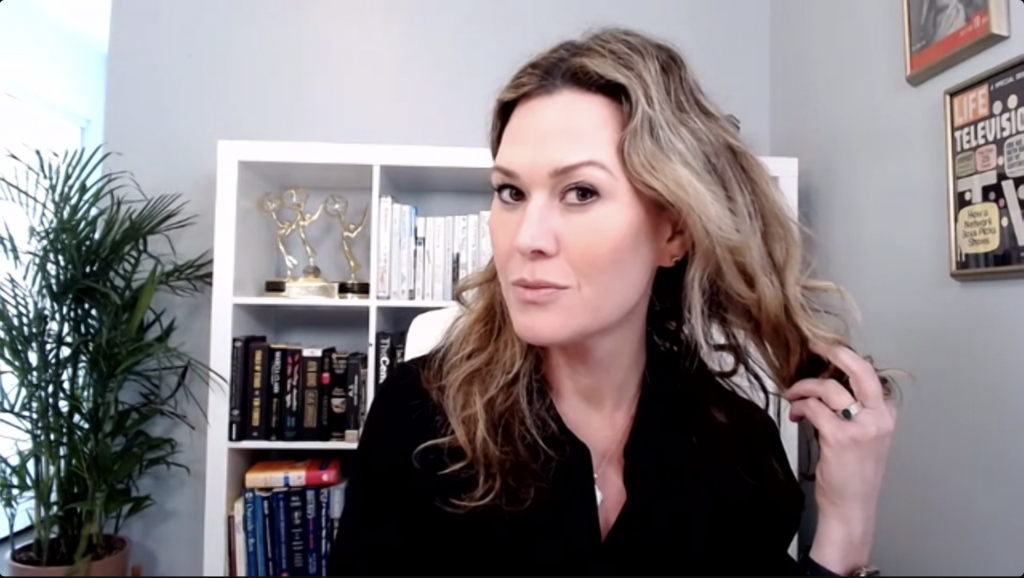
Touching your face

When we touch our face it tells the audience we’re nervous or uncomfortable.

We want to come across confident so our audience trusts us and the company we represent.

Touching your hair

When we fiddle with our hair or move it away from our face, it again makes our audience less confident in us.

Make sure your hair is always away from your face and it doesn’t move into your eyes so you don’t have a tendency to touch it.

Looking at other monitors

You wouldn’t stare out of the window or at your phone during an in-person meeting, would you?

This is why we shouldn’t look away from the person we’re meeting with and at another monitor.

You’ve seen it, you’ve felt it, you know how rude this is.

Making these small tweaks makes a huge impression on audiences.

Whether it’s an audience of one or many.

One specific VP told me recently his team is much more engaged now when he speaks.

And it happened right after he enacted the “stop touching your face” (for him, he touched his beard a lot) and “stop looking at other monitors” rules I created for him.

He says his team is more engaged.

That’s all it took.

Worth a try, right?

P.S. Want more tips? Be sure to sign up for my LinkedIn newsletter where you’ll get exclusive tips on strengthening your mindset to become a better communicator. Click here to subscribe to Thought Leaders Amplified on LinkedIn.

P.P.S. I created a training for health care professionals who need to discover their message and story, deliver it clearly, succinctly, and confidently, and present in a way that intrigues, entertains and keeps the audience’s attention. Share it with your friends in health care. Check it out even if you’re not in health care. The tips and tricks are universal. Click here to learn more.

P.P.P.S. Whenever you’re ready… here are three more ways I can help you build your brand, own your voice, and stand out:

  1. Want more tactical advice you can implement today? Check out my blog here for great articles, stories, and lessons I’ve shared over the years.
  2. Looking for one-on-one coaching or a consultation with me? Schedule a complimentary call here to speak to our team about how we can help you.
  3. Follow me on Instagram here for more media and public speaking tips, videos… and a little fun.

They’ll love your snow stories

Have you ever met a really BORING person?

Been on a first date and wondered how someone could really be that bland?

Are you sitting in a Zoom meeting right now listening to a person go on and on… about nothing?

Or worse… are you afraid you might be that person?

The best piece of advice I give thought leaders I work with before they do a media interview or speech is:

Have a relatable story.

You MUST have a story people can relate to if you’re going to attract people to you, speak in public, or if you’d like to sell your brand by using the media.

No producer or writer is going to publish a story about your grand opening or sale.

But if you have a story, like you’re donating 40% of opening day profits to a charity that’s in the news… or there’s something special about the owner… you have a much better chance.

Numbers are great – but stories are even better.

You may have a great success story at your company. Numbers are way up. Bosses are happy.

The way to break through to an audience and show what those numbers really mean is to tell a story. Explain what those numbers mean.

Talk about how many people you were able to hire because numbers are up. Highlight a person you hired and their family.

You need a compelling story of human interest.

Remember: the media has a job to do.

They need to make sure their audience watches, reads, sticks with them even after a commercial, learns something and keeps coming back for more.

All you need to do is learn a few tricks to do it the right way.

Here are a few quick thoughts I shared on YouTube.

And think about how a story connects you to people in your day-to-day Zoom meetings.

I was on a call with an exec of a Fortune 100 company last week.

He showed up in a baseball cap and a hoodie.

Not his normal wardrobe.

He told me he had just finished shoveling his wife out of the driveway.

And then he drove her to work.

She’s a nurse.

At that moment, I knew I wanted to work with that exec – and I even happily altered my price when we negotiated my contract.

Give your audience an authentic story that makes them feel something and you’ll have a better chance of seeing your story in the media.

They may even become open to negotiating their prices because they just like you.

P.S. Creating a story that stands out is the critical component needed to grow your business or practice and ensure you get an ROI on your time and energy. I shot a YouTube video on this. Check it out here.

P.P.S. I created a training for healthcare professionals who need to discover their message and story, deliver it clearly, succinctly, and confidently, and present in a way that intrigues, entertains and keeps the audience’s attention. Share it with your friends in healthcare. Check it out even if you’re not in healthcare. The tips and tricks are universal. Click here to learn more.

P.P.P.S. Whenever you’re ready… here are three more ways I can help you build your brand, own your voice, and stand out:

  1. Want more tactical advice you can implement today? Check out my blog here for great articles, stories, and lessons I’ve shared over the years.
  2. Looking for one-on-one coaching or a consultation with me? Schedule a complimentary call here to speak to our team about how we can help you.
  3. Follow me on Instagram here for more media and public speaking tips, videos… and a little fun.

The ripple effect of communication issues

How are the people inside your company communicating with your customers?

Or future customers?

I was on a call with a $12 billion company today.

I’m sharing this in case you have the same issue.

They hosted their annual meeting recently.

Many of their execs had to give presentations and they quickly realized… several of them were having issues presenting and getting their message across.

These are well-regarded individuals inside a Fortune 100 company.

They’re smart and know the industry in and out.

But they have an issue.

And it’s costly.

They are not confident or convincing when it comes to presenting.

So they called me.

They need to be prepared before they present again in a year – but more importantly, the concern is:

How are they communicating on a daily basis?

In front of customers? Potential investors? Their team?

There’s a ripple effect when it comes to communication.

Whether it’s your receptionist who takes inbound calls and walk-ins, your sales team, all the way up to your leadership — your message should:

  • establish trust,
  • be confident,
  • show empathy,
  • and it should make people want to do business with you!

If your message is being miscommunicated, at any level within your organization, that’s a potential client or customer — gone.

Potential referrals — gone.

Potential media or speaking opportunities — gone.

It’s all interconnected.

As you’re reading this, think to yourself for a moment.

Could you possibly have a communications issue inside your company?

Don’t dismiss someone as having stage or Zoom fright.

They may have a bigger communications issue.

It’s fixable and a little work now will save (and make) you a lot of money quickly.

P.S. Worried your organization is struggling like this Fortune 100 company? I created a training for health care professionals who need to confidently show up on camera, attract more patients, move up in their careers, and let their expertise shine. Share it with your friends in health care. The tips and tricks are universal. Check it out even if you’re not in health care. Click here to learn more. Want training that’s more specialized for your industry? Let’s connect and make it happen.

P.P.S. I just published a new video on YouTube sharing with you some easy adjustments to make before recording a video or going live. This might be something you haven’t considered. Check it out here.

P.P.P.S. Whenever you’re ready… here are three more ways I can help you build your brand, own your voice, and stand out:

  1. Want more tactical advice you can implement today? Check out my blog here for great articles, stories, and lessons I’ve shared over the years.
  2. Looking for one-on-one coaching or a consultation with me? Schedule a complimentary call here to speak to our team about how we can help you.
  3. Follow me on Instagram here for more media and public speaking tips, videos… and a little fun.

The missing piece to your marketing strategy

You know how important video is to connect with your audience.

I don’t need to convince you.

The stats are all there.

Video will make up 82% of all internet traffic this year.

How do you make sure your messaging doesn’t get lost?

You’re heard? Remembered?

How will you ensure your goal – the reason you want to get a message across – comes through?

I was training the CEO of a nationally known public company this week.

He was creating a video message for his employees.

He has the fancy equipment and team.

But he was missing the right words to reach his team.

And the tone and cadence.

The pieces to really move them.

Inspire them.

Make them act.

Video is powerful.

But you’re even more powerful.

So, what could you be missing from your marketing strategy?

Authenticity.

Vulnerability.

YOU.

Without YOU, video is weak.

This goes for Zoom video meetings, media interviews, website videos, social media videos and internal videos for your employees.

Don’t leave out YOU next week.

Your audiences came to the YOU party.

They chose to work with YOU.

Don’t disappoint.

P.S. If you would like help on how to be a more effective thought leader in video, in the media, and on stages, book a free consultation with me here.

P.P.S. I’ve created a special program just for healthcare professionals who need media training so they can confidently show up on camera, attract more patients, move up in their careers, and let their expertise shine. If that’s you or you know someone who can benefit from this, click here to learn more.

P.P.P.S. Whenever you’re ready… here are three more ways I can help you build your brand, own your voice, and stand out:

  1. Want more tactical advice you can implement today? Check out my blog here for great articles, stories, and lessons I’ve shared over the years.
  2. Looking for one-on-one coaching or a consultation with me? Schedule a complimentary call here to speak to our team about how we can help you.
  3. Follow me on Instagram here for more media and public speaking tips, videos… and a little fun.

How to Make Sure Your Message Takes Center Stage (and not this)

The key to any speaking opportunity – whether that’s speaking on Zoom in a meeting, on stage, in the media, in your website videos, or in job interviews – is to keep the audience focused on your message and nothing else.

There are a lot of things steering your audience away from you and your message.

A busy background.

Disrupting noises.

Or even a pair of glasses.

It’s one of the biggest questions I get:

“What do I do about my glasses?”

They’re not asking whether they should wear them…

But really – what to do about the fact that they’re distracting.

The light from their room is bouncing off the lenses…

They know they need help.

I struggled with this for so long – I just ditched my glasses for years… which has made it pretty hard to see my slides when I’m training.

But I figured out some tricks.

And I’m going to share a little bit with you now.

(If you want to go more in-depth with me, click here to watch this video I just shot.)

Do you have big thick frames?

Or are they too small and cutting off your pupils?

While glasses may sometimes feel like an afterthought, they could be detrimental to your overall message.

You want your audience to connect with your eyes.

The eyes are the window to the soul (or so I’ve heard).

This is also why it’s important to look directly into the camera. You’ll appear as if you’re looking right into the eyes of your audience.

This takes practice to get it down and not let your eyes wander off and look at all the other people on the call.

When you let your eyes move from person to person or somewhere else in your room, you may appear to be insincere, detached, uninterested, insecure, and even shifty.

When someone can really look into your eyes — they feel more connected to you. AND TRUST YOU MORE.

That’s why I care about this.

It’s not about looks.

I care that you connect with more people.

And they trust you.

P.S. I left out one of the other big no-no’s when it comes to making sure you connect with your audience and stand out. I’m talking about lighting. I just published a short video telling you all about it. Click here to watch.

P.P.S. I’ve created a special program just for healthcare professionals who need media training so they can confidently show up on camera, attract more patients, move up in their careers, and let their expertise shine. If that’s you or you know someone who can benefit from this, click here to learn more.

P.P.P.S. Whenever you’re ready… here are 3 more ways I can help you build your brand, own your voice, and stand out:

  1. Want more tactical advice you can implement today? Check out my blog here for great articles, stories, and lessons I’ve shared over the years.
  2. Looking for one-on-one coaching or a consultation with me? Schedule a complimentary call here to speak to our team about how we can help you.
  3. Follow me on Instagram here for more media and public speaking tips, videos… and a little fun.

How to be more entertaining & interesting in 2022

I just spent a month working from Florida.

It’s nice to get away from the Chicago cold.

Plus, my mom lives there.

Have you ever noticed how honest your family is?

Your colleagues may not tell you about your flaws… but, man… your family will.

When I was young (and sometimes still now), my mom would say, “Kathryn, the Reader’s Digest version, please!”

Reader’s Digest is the largest subscriber-based magazine in the world. It features short stories, jokes, and advice.

I loved reading it when I was younger. But I couldn’t for some reason, tell a story succinctly like the “Reader’s Digest version.”

It’s easier when you write. When you write, you can go back and edit yourself. I highly recommend that and we’ll talk about how to in a moment.

When we’re telling our story on stage, in the media, on a panel, during a wedding toast, in a job interview, or even just on a date, we don’t have that editing function always working in our brain.

We can drone on and on… which isn’t good.

If your editing skills aren’t honed, you could be seen as boring, annoying, and worse: it could actually cost you that job, date, or client you’re hoping to land.

Preparation is key.

Don’t go into any important conversation or interview without first outlining what questions you may receive and how you should answer them to make your audience act.

Write your story, toast, elevator pitch, speech, or those job interview answers out. Once you see it on the page, it will become more apparent what can stay and what needs to go.

What are you headlines? The soundbites people will remember? The quotes they may tweet? What are the takeaways?

Practice your story over and over, and do it out loud.

Find someone you trust to tell you the truth.

Tell the person you’re practicing with to stop you where they get bored, where they feel they had enough… and where they are no longer entertained.

Record yourself.

Play it back.

Listen to your delivery.

Watch your body language.

You’ll notice your energy wane when you’re no longer interested.

If you’re bored – that’s a good signal to cut that piece out.

Be okay with the editing.

Develop a thick skin, but also stay vulnerable. This is your story. Your baby. Your life history. It’s important to be passionate about your story, but at the same time, be okay with the editing.

Know when to let go of what’s not as engaging to other people.

When the mission is to engage, entertain and teach — edit yourself down to what’s essential and entertaining.

You have one shot to keep your audience.


While I have you…

I’ve created a special program just for healthcare professionals who need media training so they can confidently show up on camera, attract more patients, move up in their careers, and let their expertise shine. If that’s you or someone you know who can benefit from this, click here to learn more.

If you’re looking for tips, tricks, and techniques on public speaking, landing media interviews, or creating a message that stands out, check out and subscribe to my YouTube channel. I’m dedicating 2022 to publishing up-to-date and timely videos for you.

And whenever you’re ready… here are two more ways I can help you build your brand, own your voice, and stand out:

  1. Looking for one-on-one coaching or a consultation with me? Schedule a complimentary call here to speak to our team about how we can help you.
  2. Follow me on Instagram here for more media and public speaking tips, videos… and a little fun.

It’s not an overnight success: How my healthcare client launched a public speaking career & published her book

Sometimes we see someone on TV, in a TEDx, on Instagram… and think, wow, she really made it.

We don’t see all the work that went into it.

No success is overnight.

Nothing is instant.

I can tell you from personal experience that no matter how famous or wealthy, celebrated or successful someone becomes, there is always a “before.” There are also coaches, experts, allies, and in some cases good therapists.

Lately, I’ve been reflecting on how grateful I am to have witnessed my friend Joyce Marter’s “before.” And how lucky we are that Joyce has published a book about how we can all transition from “before” to something more in terms of our health and wealth. 

Joyce founded and sold Urban Balance, a holistic mental health practice. She integrated her own family-first approach into Urban Balance’s culture, bringing on board other moms who wanted to work part-time and offering flexible work schedules. Urban Balance faced some of the same financial challenges encountered by most small businesses, including a bumpy cash flow that jeopardized timely payroll and rent payments. Joyce found a strong CPA and other experts to fill in some of her own blind spots. The accounting expertise helped right the ship and ultimately, set the company up for a profitable sale. This freed Joyce up to focus on the work she most enjoyed — writing and traveling to speaking engagements as a means of sharing with a broader audience what she had learned in her clinical practice. 

During this transitionary period, Joyce started wondering about a central question: Does prosperity lead to happiness, or is it the other way around? She reflected on a trend she’d been seeing with her clients: as their mental health improved, her clients also began experiencing raises, promotions, or better jobs; and many clients even started their own businesses. Joyce began to formalize a process by which she had helped her clients unlock the door to a life of personal health and financial wealth. Mental health and financial health are deeply interrelated, she reasoned. She knew money problems can trigger deep-rooted issues around self-worth, identity, and fear. But, she asked, what if you could shift your mindset around finances and open yourself up to a world of mental wellness and holistic success?

I began working with Joyce at the beginning of her public speaking career. I recognized her clear talents right away, and helped bring her professional speaking, media presence, branding, and image to the next level. By giving her honest feedback, like I do with all my clients, she was able to grow as a speaker and media contributor — and her confidence grew significantly. I helped her OWN her worth. 

As Joyce would often reflect during our meetings, “Mental health is the key to unlocking a life of prosperity, joy, and happiness. Too many of us are stuck in a rut of negativity. Phrases like ‘I’m not worthy’ and ‘I can’t do this’ are uttered far too frequently. From money to relationships to career and more, we’re consistently selling ourselves short. These thoughts contribute to our limiting beliefs about ourselves, our lives, our finances, and what we’re worthy of—and they’re 100% false.” 

Joyce codified her insights into a book–the culmination of years of Joyce’s work as a therapist, but also the result of her own personal journey towards an abundance mindset. In The Financial Mindset Fix, Joyce aims to help readers shift their mindset around finances and open themselves up to a world of mental wellness and holistic success in the process.

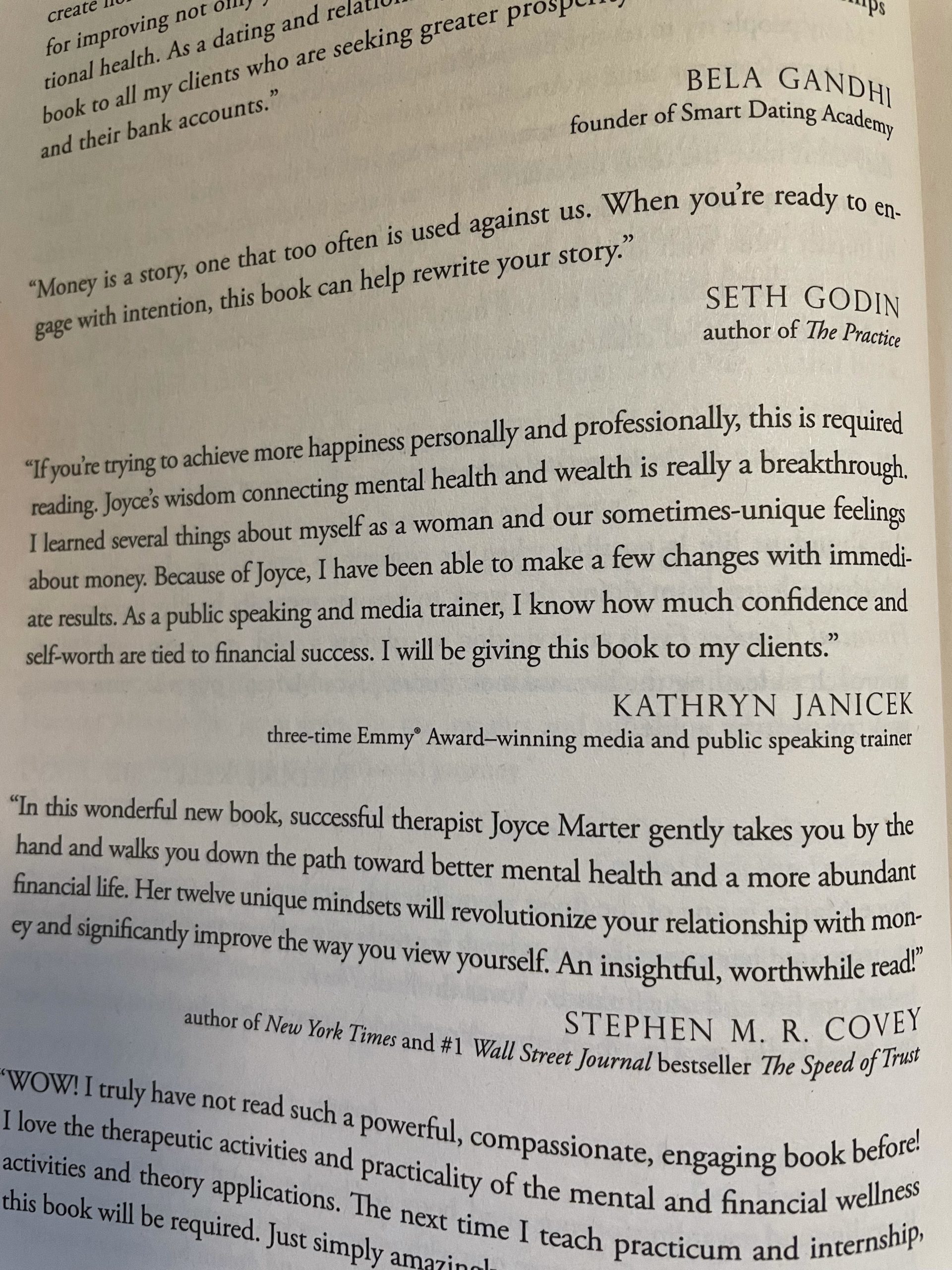
I’ve read an advance copy of the book, and it’s a life-changer. If you aim to be happier in your personal and professional life, The Financial Mindset Fix deserves a prominent spot on your bedside table. Joyce’s wisdom connecting mental health and wealth is really a breakthrough. Frankly, I learned several things about myself (associated with my gender’s sometimes-unique feelings about money), and I’ve made a few tweaks with immediate results. As a public speaking and media trainer, I know how much confidence and self-worth are tied to financial success. I will be giving this book to my clients. 

But don’t just take my word for it. Best-selling author Stephen M. R. Covey said, “In this wonderful new book, successful therapist Joyce Marter gently takes you by the hand and walks you down the path toward better mental health and a more abundant financial life.” And entrepreneur, best-selling author, and speaker Seth Godin said, “Money is a story, one that too often is used against us. When you’re ready to engage with intention, this book can help rewrite your story.” Yep, totally agree, gentlemen. 

Here’s my own review that you can see on Amazon (and it’s inside her actual book). I’m sandwiched right between Seth Godin and Stephen Covey.

Kathryn Janicek's review of The Financial Mindset Fix by Joyce Marter

As Joyce says, “Your personal beliefs about money can drive you to exhaustion or liberate you. Do you want the never-ending panic of scarcity or the freedom and joy of prosperity?”

The choice is obvious, right? I’m thrilled to have witnessed Joyce’s inspiring journey, and to have played a small part in her success.

I’m also the media coach and public speaking trainer who helps you present at a higher level, tell your story, and gain media attention. So do yourself a favor and read the book. Who knows? Maybe someday soon, I’ll be celebrating your journey, as well. 

If you’d like to order Joyce’s new book, you can do that here:

https://www.joyce-marter.com/book/the-financial-mindset-fix/

Happy Reading!

Warmly,

Kathryn